Testimony of Rachel Neches
Senior Data & Policy Researcher, Center for an Urban Future
Before the New York City Council Committee on Higher Education
November 24, 2025
Good morning. I’m Rachel Neches, Senior Data & Policy Researcher at the Center for an Urban Future, an independent think tank focused on a stronger and more inclusive economy in New York. Thank you to Chair Dinowitz and members of the Committee for the opportunity to testify.
College degrees matter for economic mobility; in New York City, residents with a bachelor’s degree earn twice as much as those who only have a high school diploma ($78,000 versus $40,000). That’s why any effort to build a more equitable economy will fall short without bold new commitments to ensure many more New Yorkers can earn a college credential.
Despite steady progress in recent years, New York City still has a long way to go in boosting college attainment. New York ranks just 15th out of 25 major U.S. cities for residents with a bachelor’s degree or higher.
Today, most good jobs go to those with postsecondary degrees, yet wide disparities in college attainment rates drive unequal economic outcomes: just 24 percent of Hispanic New Yorkers and 31 percent of Black New Yorkers hold a bachelor’s degree, compared to 69 percent of white New Yorkers. In many communities—from Mount Hope and Mott Haven to East New York and East Elmhurst—fewer than 30 percent of working adults have a college degree.
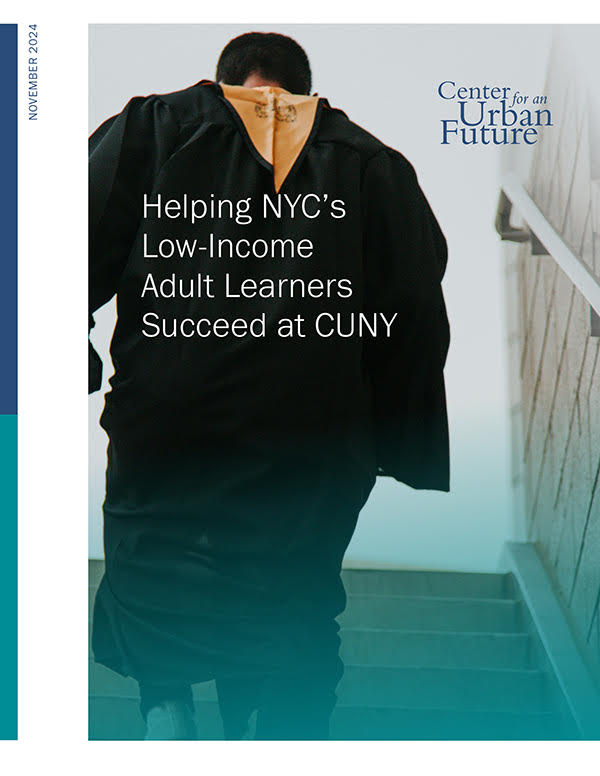
No institution is better positioned to change this trajectory than CUNY. But too many students— especially low-income students, first-generation students, part-time students, and working adults—struggle to complete their degrees. And while graduation rates have improved meaningfully over the past decade, the system still has a long way to go.
Today, graduation rates range widely across CUNY campuses, programs, and students. The six-year graduation rate for first-time, full-time students seeking bachelor’s degrees at Baruch College is 75 percent; at Medgar Evers, it’s 26 percent. Among first-time, full-times students seeking associate’s degrees, the three-year graduation rate at Kingsborough is 27.7 percent; at Hostos, it’s 16.2 percent.
And challenges vary across student populations. While the six-year system-wide graduation rate for full-time, first-time students is 57.9 percent, its 50.7 percent for Hispanic students, 45 percent for Black students, 43.1 percent for students over 25, and 21.6 percent for part-time students. Yet these are often the students who stand to benefit the most from a CUNY degree.
That’s why getting students the right supports to persist and succeed is so important. The Center for an Urban Future recommends that the city pursue three key strategies to get more students to the finish line.
1. Set a bold 10-year goal to achieve a 50 percent increase in the number of Black, Latino, and Asian New Yorkers with a college credential—with a focus on closing gaps in the city's lowest-income communities.
A long-term goal can help keep college attainment outcomes front and center, but only if supported by the right policies and investments to get there. We recommend that the City Council and Mayor’s Office establish a 10-year target for boosting college attainment citywide with a focus on New Yorkers who are underrepresented among college graduates today. This should be coupled with new efforts to boost graduation rates across CUNY by investing in proven college success programs.
2. Scale up CUNY ACE to match the transformative impact of ASAP.
CUNY ACE provides students attending CUNY’s senior colleges with academic advisement, career development, scholarships, textbooks, and transportation assistance, and has boosted graduation rates for its participants by as much as 40 percent. But limited funding means it serves just 3 percent of all eligible students. As it effectively did for CUNY ASAP, the Council should scale up CUNY ACE to reach many more full-time senior college students.
3. Pilot the launch of CUNY Flex.
Part-time students consistently graduate at much lower rates. We urge the Council to support a CUNY Flex pilot—a program modeled on CUNY ASAP and ACE for part-time students—offering flexible scheduling, OMNY Cards, one-on-one advising, and free technology. CUNY Flex would better meet the needs of working and adult learners who find it impossible to enroll full-time.
CUNY has made real progress in improving student success, but significant gaps remain. With a clear long-term vision and sustained investment, the city can help far more students earn a degree, secure good jobs, and move up the economic ladder.
Thank you for the opportunity to testify today and for your commitment to boosting graduation rates at CUNY—and expanding pathways to a college degree for more New Yorkers.