Testimony of Eli Dvorkin
Editorial & Policy Director, Center for an Urban Future
Before the New York City Council Committee of the Whole
Oversight Hearing Examining the Risks Posed by Artificial Intelligence
October 5, 2026
Good morning, Speaker Menin and members of the City Council. My name is Eli Dvorkin, and I am the editorial and policy director at the Center for an Urban Future, an independent research organization focused on expanding economic opportunity in New York City. Thank you for the opportunity to testify today.
Artificial intelligence is reshaping New York City’s economy in ways that create significant opportunities and major new challenges. Our research shows that one consequential disruption is already underway: entry-level tech hiring in the city has fallen off a cliff, making it much harder for recent college graduates and graduates of tech training programs to gain an economic foothold.
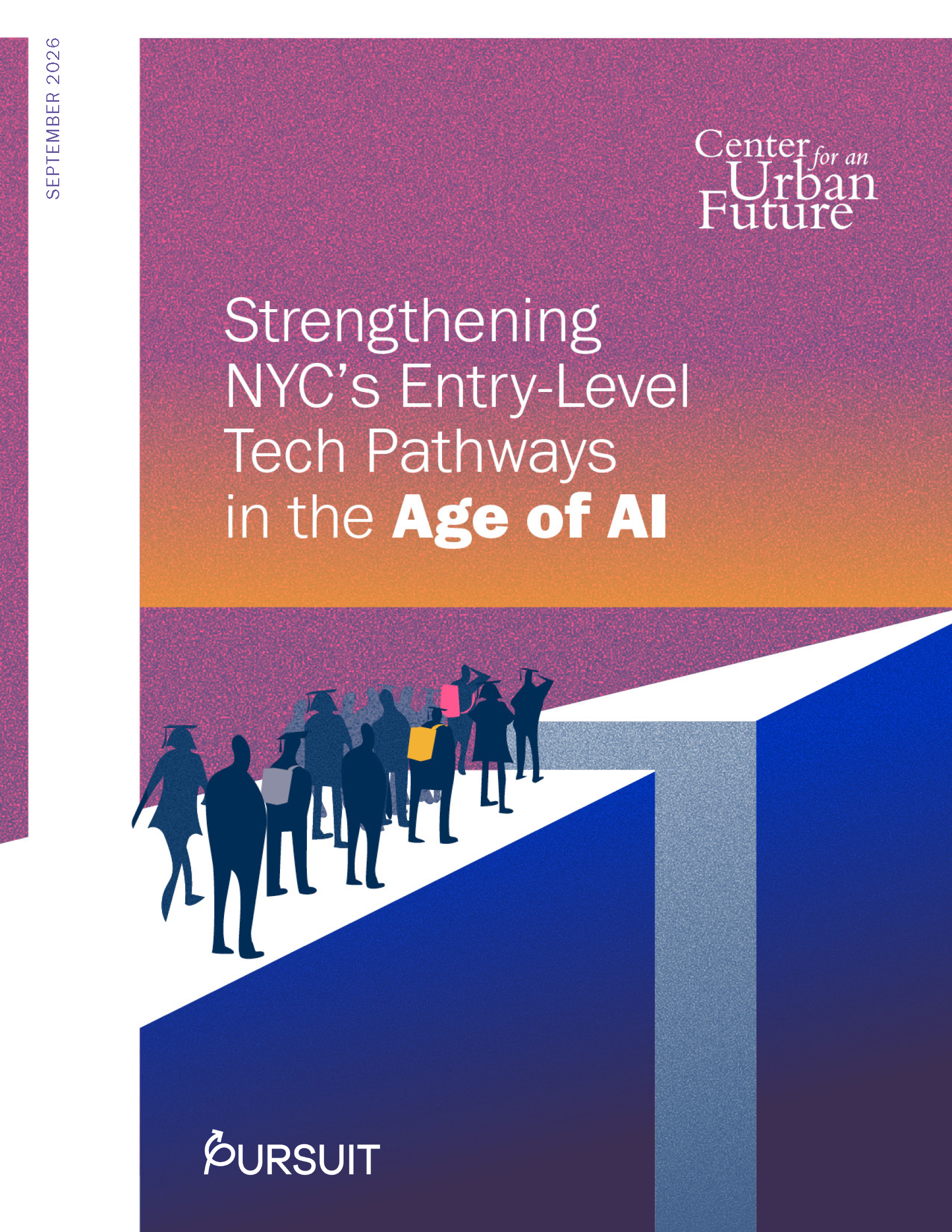
Tech remains critically important to New York City’s economy. Employment in the city’s tech sector is up 24 percent since 2019, providing a critical source of middle- and high-wage jobs. But in our new report, Strengthening NYC’s Entry-Level Tech Pathways in the Age of AI, we find that entry-level tech job postings in New York City have plummeted 49 percent since 2022. The overall tech economy has remained comparatively resilient, but the first rung of the ladder has become dramatically harder to reach.
AI is clearly not the only factor behind this decline. Higher interest rates, economic uncertainty, the pullback from the pandemic-era hiring boom, and other forces have all contributed. But the relationship between AI exposure and shrinking entry-level opportunity is striking.
Our analysis found that entry-level job postings in occupations with the greatest exposure to generative AI fell 29 percent from 2022 to 2025. By contrast, entry-level postings in occupations with minimal exposure to generative AI increased 21 percent over the same period.
At the same time, AI is creating new opportunities. Entry-level job postings requiring AI skills have increased 20 percent since 2022, even as most other areas of tech hiring contracted. These opportunities are also spreading beyond the tech sector into finance, professional services, health care, and education.
The challenge facing New York is not that technology is eliminating jobs, at least not based on the evidence available today. It is that the pathways into good jobs are contracting, and New Yorkers who have historically faced the highest barriers to accessing well-paying careers risk being left behind.
This shift is already creating major challenges for New York’s exceptional ecosystem of education and workforce training organizations. Employers that until recently hired dozens of their graduates each year have sharply curtailed entry-level hiring, in some cases nearly to a standstill. At the same time, graduates are increasingly competing for junior roles with Ivy League graduates and recently laid-off tech workers who already have two or three years of professional experience.
These pathways are not broken. But they are under significant strain at precisely the moment when experience matters more than ever to employers, putting some of the city’s most important economic mobility pathways at risk.
This is a problem that government should help solve. Our report identifies several practical steps city leaders can take.
First, launch an NYC AI Service Corps. The city should create a paid, six-month fellowship placing emerging technologists in city agencies, nonprofits, and small businesses to work on practical AI and technology projects. This would give early-career New Yorkers the hands-on experience employers increasingly demand while helping organizations that often lack the resources to adopt new technologies effectively. CUF proposes launching the initiative with city funding alongside investment from major AI and technology companies and philanthropy.
Second, enlist many more of New York City’s large and mid-sized employers in creating paid pathways to careers. City Hall should work with employers to significantly expand internships, apprenticeships, and other work-based learning opportunities in partnership with CUNY and workforce development organizations. There is already a strong model: the New York Jobs CEO Council has partnered with CUNY to create paid apprenticeships and other pathways into employment. But far too few large and mid-sized employers beyond this first group have been recruited. City Hall should use its convening power to recruit the next 100 large and mid-sized employers to build well-defined pathways into good jobs, while supporting one or more employer-facing intermediaries that can help companies navigate CUNY and the workforce ecosystem, identify talent needs, and connect with skilled candidates.
Third, establish a Workforce AI Readiness Fund. New York City should create the nation’s first dedicated fund to help workers and workforce organizations respond to AI-driven labor market change. The fund should support three areas where innovation will be required: rapid upskilling and reskilling, job transitions for directly affected workers, and expanded opportunities for early-career talent to gain hands-on work experience.
The future of New York City’s tech economy remains strong. But preserving access to this vital engine of economic mobility will require reimagining the on-ramps into it. If entry-level pathways continue to narrow, thousands of New Yorkers could lose access to family-sustaining careers, while employers lose an important source of diverse, homegrown talent.
City leaders have an opportunity to act now, focusing on the parts of this transformation where local government has the greatest power to make a difference: helping more New Yorkers gain the experience, skills, and connections they will need to navigate an economy reshaped by AI.
Thank you for the opportunity to testify.



_291_388_bor1_a4a4a4.jpg)