This past fall marked a decade since New York City launched its landmark Computer Science for All (CS4All) initiative. Ten years later, with AI transforming the city’s economy and reshaping the skills that New Yorkers need to access well-paying jobs, the city needs a CS4All 2.0: a recalibrated effort for a very different tech era that goes even deeper on computing education in the city’s public schools, expanding on CS4All’s strengths, closing persistent gaps, and reimagining key elements for the needs of today’s students and tomorrow’s economy.
This data brief provides a backdrop for understanding the way forward. It illustrates the achievements of CS4All, which the city established in 2015 with the goal of ensuring that every student would receive computer science education by 2025, while also showing the work that remains to make computing education a core component of every student’s K–12 experience.
We conclude that CS4All has had remarkable success in expanding access to computing education for public school students throughout the five boroughs. At the same time, however, the data also show that access is not the same as participation: most of the city’s public school students still do not enroll in computer science classes in any given year, with persistent gaps by race, gender, borough, and district.
Our findings include:
Signs of Progress
- CS4All has helped nearly quadruple the share of students enrolled in computer science classes in any given school year, from 54,177 (5.5 percent) in 2016 to 193,171 (20 percent) in 2024, a significant achievement.1
- Today, 93 percent of schools are reaching at least some of their students with computer science in each grade band (K-2, 3-5, 6-8 or 9-12).2
- The number of computer science classes multiplied tenfold, from 534 in 2016 to 5,005 in 2023.3
- CS4All has made important progress in growing computer science participation among Black, Hispanic, female, low-income, and English language learner students.
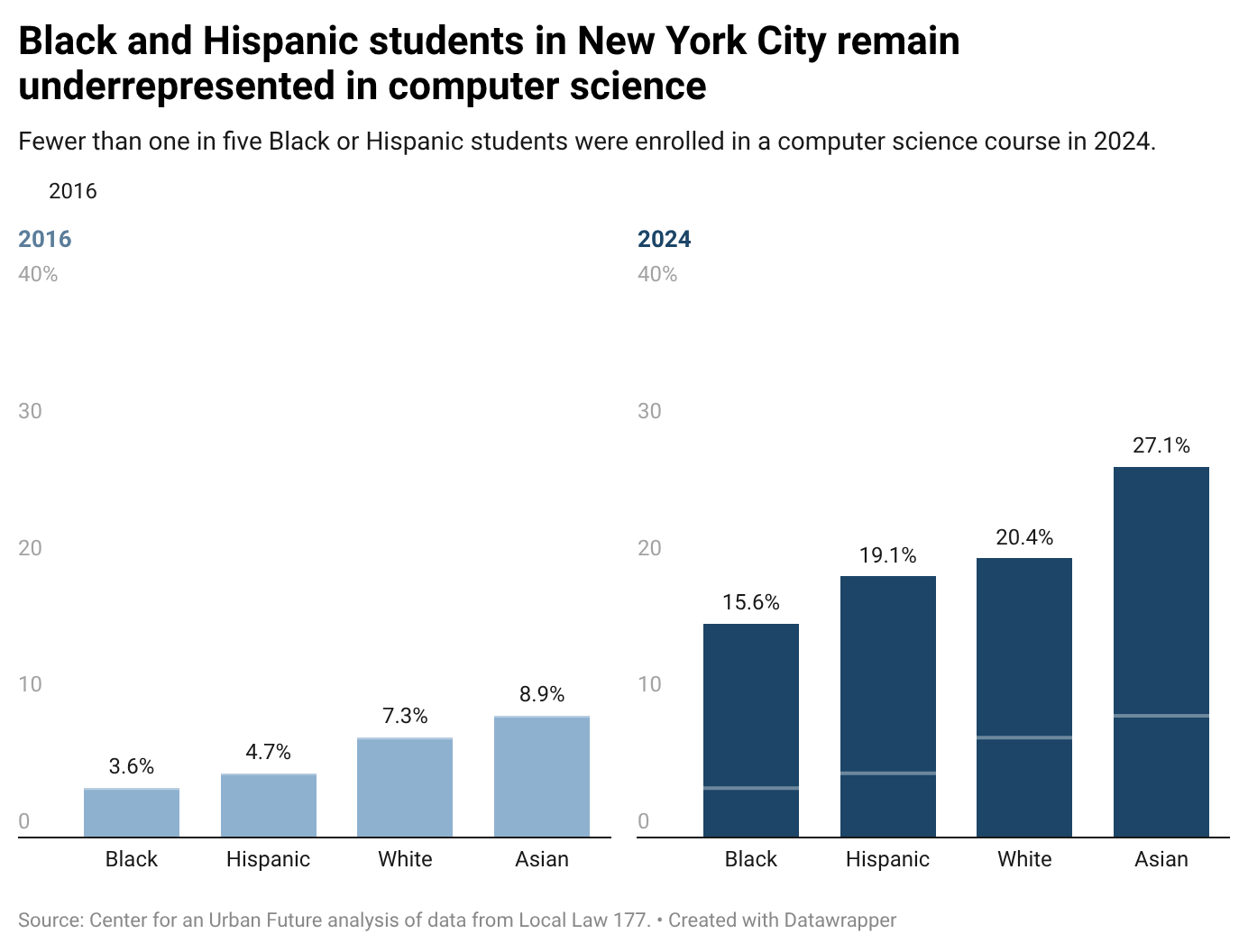
- From 2016 to 2024, enrollment more than quadrupled among Hispanic students (from 4.7 to 19.1 percent) and Black students (3.6 to 15.6 percent).4
- Female student enrollment grew faster (5.1 to 19.5 percent) than male enrollment (5.9 to 20.5) from 2016 to 2024, although a gap persists.5
- The share of English language learners taking computer science classes (23.3 percent) surpassed the share of non-English language learners taking computer science classes (19.3 percent) as of 2024.6
- At the local level, some changes were even more dramatic.
- District 23 (located in Brownsville and Ocean Hill), which serves a majority Black and Hispanic student body and has a poverty rate of 92.3 percent,7 saw the fastest growth in computer science student enrollment, rising from just 17 students in 2016 to 1,575 in 2024.8
Disparities Remain
- Most students—many of them low-income and students of color—still do not enroll in computer science classes. Citywide, just 20 percent of students were enrolled in computer science classes in 2024, and no school district has more than 47 percent of its students enrolled in computer science classes.9
- Overall, only 38 percent of students have had one or more computer science experiences during their three- or four-year grade band (K-2, 3-5, 6-8, 9-12).10
- Just 19 percent of schools are meeting CS4All’s equity goals, meaning that Black and Hispanic students and girls are underrepresented in computer science in more than 4 in 5 schools citywide.11
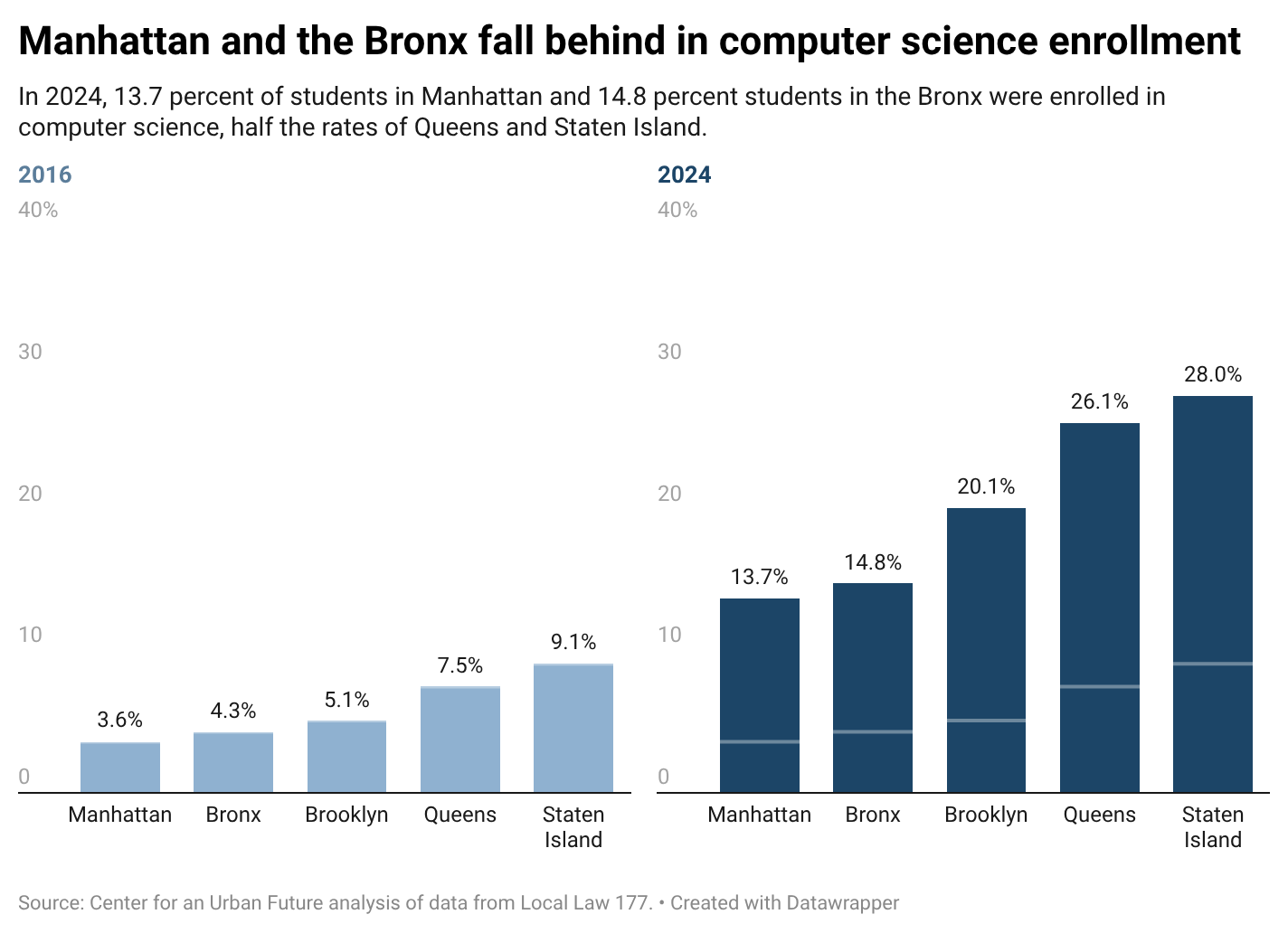
- Participation varies sharply by borough: While 28 percent of students in Staten Island and 26.1 percent in Queens were enrolled in computer science, only 14.8 percent of Bronx students and 13.7 percent of Manhattan students were.12
- Just 15.6 percent of Black students and 19.1 percent of Hispanic students were taking computer science classes in 2024, compared to 27.1 percent of Asian students and 20.4 percent of white students.13
_(1).png)
City leaders should launch a CS4All 2.0 built for the AI era
New York City has begun taking important steps to help schools adapt to the AI era, including the launch of initial guidance around AI in the classroom. But the bigger challenge is still ahead: relaunching the city’s computing education initiative for a fundamentally different world. When AI can now write code at the level of a senior software engineer, the divide is no longer simply between students who learn to code and those who do not. It is between students who understand how technology works, how to question it, and how to use it creatively, critically, and responsibly—and those who remain passive consumers of it.
That is why Mayor Mamdani and City Council should champion a CS4All 2.0: a renewed citywide effort to boost participation, close persistent gaps, and reimagine computing education for a fast-changing world. This should include expanding evidence-based, age-appropriate, and joyful instruction in computational thinking across grade levels, while making teacher preparation a central part of the strategy. The city can start by fully funding CUNY’s Computing Integrated Teacher Education initiative, which is helping future teachers integrate computer science and digital literacy into their classrooms, and by creating a stackable Computing Across the Curriculum Microcredential for aspiring teachers, current educators, and after-school instructors, aligned with New York State’s Computer Science and Digital Fluency learning standards. Together, these investments can help make equitable computing education a meaningful part of a sound basic education for all New York City students.
Endnotes
1. Center for an Urban Future analysis of New York City Department of Education Local Law 177 data from 2016 and 2024.
2. “Expanding Computer Science Education for All: Successes, Challenges, and Implications of NYC’s CS4All Initiative,” Cheri Fancsali and June Mark, with Kathryn Hill, Xia Li, Janice Lee, Rishika Jain, and Michelle Flores, The Research Alliance for New York City Schools, December 2024, https://steinhardt.nyu.edu/research-alliance/research/expanding-computer-science-education-all.
3. Ibid.
4. Center for an Urban Future analysis of New York City Department of Education Local Law 177 data from 2016 and 2024.
5. Ibid.
6. Ibid.
7. New York City Department of Education, Demographic Snapshot: SY 2019-20 to 2023-24, https://infohub.nyced.org/reports/students-and-schools/school-quality/information-and-data-overview.
8. Center for an Urban Future analysis of New York City Department of Education Local Law 177 data from 2016 and 2024.
9. Ibid.
10. “Expanding Computer Science Education for All: Successes, Challenges, and Implications of NYC’s CS4All Initiative,” Cheri Fancsali and June Mark, with Kathryn Hill, Xia Li, Janice Lee, Rishika Jain, and Michelle Flores, The Research Alliance for New York City Schools, December 2024, https://steinhardt.nyu.edu/research-alliance/research/expanding-computer-science-education-all.
11. Ibid.
12. Center for an Urban Future analysis of New York City Department of Education Local Law 177 data from 2016 and 2024.
13. Ibid.