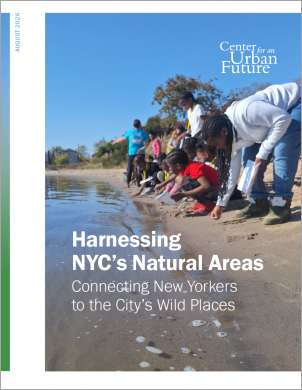
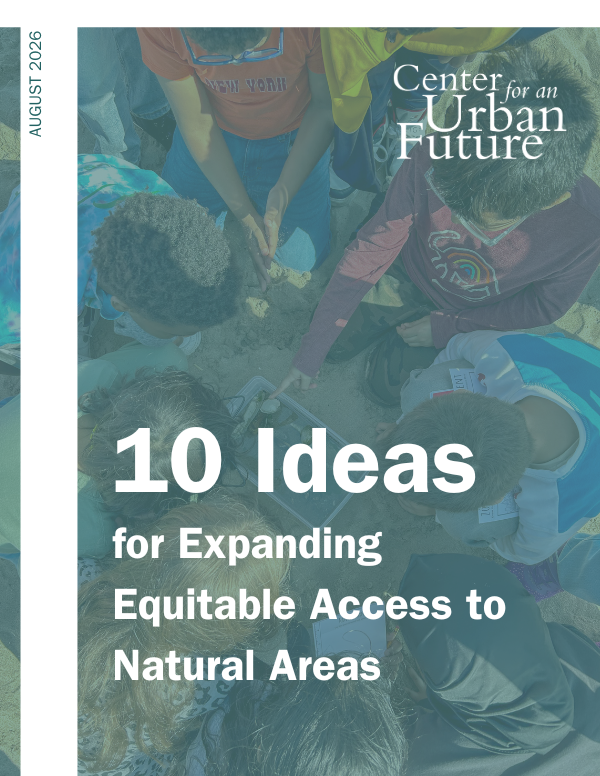
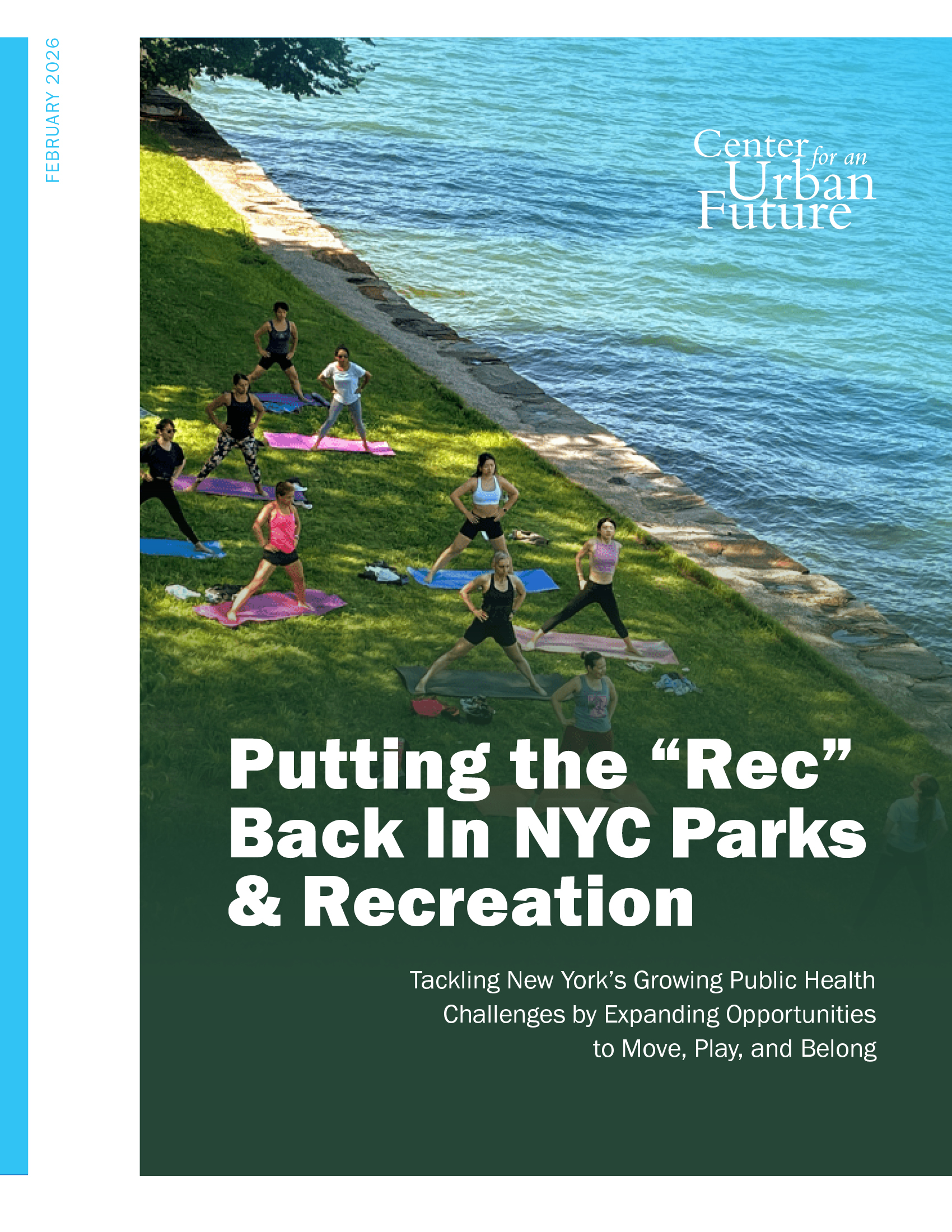
New Yorkers are more stressed, more screen-bound, and more disconnected than ever, and one of the most effective antidotes is hiding in plain sight: the more than 12,000 acres of city-managed forests, wetlands, streams, and other wild landscapes woven across the five boroughs.1 From the wooded trails of Central Park’s North Woods to the salt marshes of Jamaica Bay, the forests of Staten Island’s Greenbelt, and the rocky shoreline of Pelham Bay Park, New York City boasts a treasure trove of natural areas. These local assets provide access to nature for the millions of New Yorkers without the means to visit hiking trails or waterfronts in the Hudson Valley, Long Island, or other parts of the surrounding region.
But despite their scale and potential, the city’s natural areas remain largely invisible and underused. While about half of New Yorkers use the city’s public parks each week, far fewer are experiencing the city’s natural areas. Only about 380,000 New Yorkers—about 4.5 percent of the city’s population—participated in nature-based programming in 2024, including programming offered by NYC Parks, according to a survey of over two dozen entities conducted for this report.2 And because many are repeat visitors, the share is likely even lower.
Even in the city’s most prominent natural landscapes, engagement is limited: In Jamaica Bay, only about 4 percent of park activity is tied to nature-focused uses like hiking or birding.3 Among young New Yorkers, the gap is even more pronounced, with programs like Trail Blazers reporting that up to 80 percent of participants do not regularly access green space, even when they live nearby.
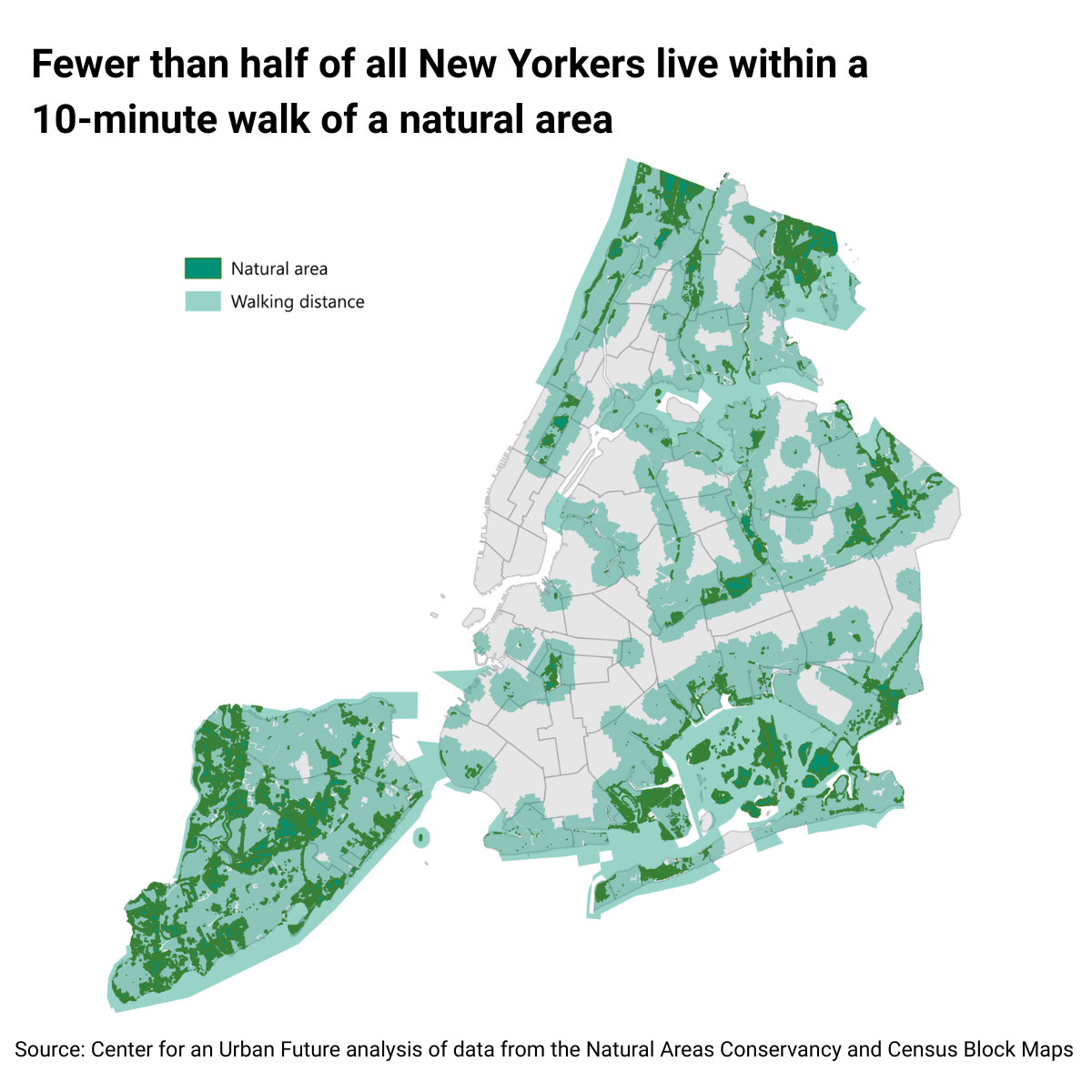
For many residents, especially in lower-income communities and communities of color, spending time in nature can feel like a largely inaccessible luxury. According to the educators and youth development practitioners interviewed for this report, many young New Yorkers go their entire childhoods without ever setting foot in one of the city’s forests, wetlands, or other natural areas. Part of the challenge is physical proximity: Fewer than half of all New Yorkers live within walking distance of a natural area, and more than 2.2 million residents live in neighborhoods with none at all.4 But our interviews with community leaders suggest that cultural perceptions and questions of who feels welcome in these spaces also play a role.
Where lower-income New Yorkers are accessing these spaces, it is often through community-based nonprofits. But where these programs exist, demand far exceeds capacity. At the Hood Hikers, a community-based organization that organizes hiking trips centered on Black and Brown residents, membership has grown to more than 5,000 since its founding in 2020, and every event sells out. At Shorewalkers, a long-running nonprofit that leads group walks and hikes across the city using public transit, the annual Great Saunter around Manhattan now draws thousands of participants and fills up in less than a day. (This year saw 3,500 walkers on the route, and another 3,000 on the waitlist.) And at the Sebago Canoe Club in Canarsie—a volunteer-run organization offering free kayaking and waterfront access along Jamaica Bay—staff and volunteers regularly struggle to accommodate waitlists.
At the same time, New York City’s natural areas are under growing strain, and receiving less support. Although these landscapes make up roughly one-third of all parkland, they receive just 2 percent of the city’s parks operating budget.5 The city’s capacity to care for these spaces has declined sharply: Acres maintained have fallen from 1,224 in fiscal year (FY) 2023 to 569 in FY 2025—a drop of more than 50 percent in two years—while tree planting in natural areas has also declined significantly.6 Last year, just 4.7 percent of natural areas received any maintenance, and the entire system is managed by just 102 staff.
To its credit, NYC Parks and its partners have built important foundations to expand access and care. Urban Park Rangers and Stewardship programs have long connected New Yorkers to the city’s wild spaces; the Natural Areas Conservancy (NAC) has advanced trail planning and restoration; and the city recently released its first-ever Urban Forest Plan. But the scale of need now far exceeds the resources available. Our research suggests that realizing the promise and potential of the city’s natural areas for the benefit of all New Yorkers will require sustained investment in staffing and maintenance, stronger awareness and wayfinding, and new approaches to programming, partnerships, and funding—including tapping private and philanthropic support alongside public dollars. This report advances research on the state of the natural areas care and access ecosystem, and surfaces ideas from that research to ensure every New Yorker can experience meaningful time in nature without leaving the city.
Research for this report, supported by a grant from The Leona M. and Harry B. Helmsley Charitable Trust, draws on interviews with more than 65 parks leaders, natural areas advocates, environmental education organizations, community-based nonprofits, parks and open space alliances, and stewardship groups across the five boroughs. The research is also informed by an extensive analysis of public data from NYC Parks and other sources.
New York City’s natural areas may be one of its most untapped assets. They offer a rare combination of benefits that are especially important in a city like New York. A growing body of research shows that time in nature—even as little as 15 minutes—can reduce stress, improve mood, and support mental health, with the strongest benefits linked to more immersive settings like urban forests.7 These impacts are especially pronounced for young people, at a time when nearly 40 percent of New York City high school students report feeling persistently sad or hopeless, the highest rate on record.8
Natural areas also serve as living classrooms, offering hands-on environmental education and workforce pathways, while playing a critical role in mitigating climate impacts, from absorbing stormwater to reducing extreme heat. And at a time when the city feels more unaffordable than ever, these spaces offer one of the few opportunities for New Yorkers to access meaningful recreation and respite at no cost.
They also play a critical role in addressing environmental inequities. In neighborhoods along the Bronx River, for example, natural areas help mitigate the impacts of pollution, extreme heat, and noise from nearby highways, providing measurable improvements to both environmental and public health conditions. “When you go into a thicket of trees, that changes,” says Victoria Toro, outreach manager of the Bronx River Alliance, a nonprofit that cares for and programs activities on the Bronx River. “Natural areas mitigate the extreme heat, pollution, and noise that is so damaging to people’s mental and physical health. And these spaces are cleaning the air, too. We’re full of these hidden gems that people don’t know how to physically get to.”
Indeed, despite the many benefits provided by the city’s natural areas, access remains highly inconsistent, and too few New Yorkers are even aware of them.
A new Center for an Urban Future analysis finds that fewer than half of all New Yorkers—47.7 percent, or about 4.2 million people—live within a 10-minute walk of a natural area, compared to more than 84 percent who live within walking distance of a park.9 Our analysis also found that just over a quarter of New Yorkers—26.1 percent, or roughly 2.2 million people—live in City Council districts without access to natural areas at all. Even along the city’s extensive coastline, access is limited: Of 520 miles of waterfront, only about 40 percent is publicly accessible.
Even where natural areas exist nearby, many New Yorkers remain unaware of them. In Manhattan’s Inwood Hill Park, which contains one of the city’s last remaining old-growth forests, Elizabeth Jaeger, former deputy director of the NAC, recalls working with a local videographer to capture its trail system. “He said, ‘This was an easy job for me, I live in Inwood Hill,’” she says. “I said, ‘That’s great, you must love coming to this park.’ He told me he had never been there.” The experience is not unusual. “In almost every workshop we do, we hear the same thing,” Jaeger says.
This gap between proximity and awareness means that even in neighborhoods with access to natural areas, many residents are not benefiting from them—underscoring the need not only to expand access, but to make these spaces more visible and welcoming to the communities they serve.
While most New Yorkers still do not regularly access the city’s natural areas, those who could benefit most are often the least likely to do so.
At NYC Outward Bound Schools, which fosters adventurous learning through real-world engagement and meaningful challenge in schools and the outdoors, staff report that many participants are visiting major parks and natural areas for the first time, even when they live nearby. Despite New York City’s abundance of green space, many of the students the program serves do not experience natural areas as truly accessible. “For many young people, it’s actually the first time they’ve been there,” says Cal Hastings, the organization’s vice president of partnerships and innovation. “Experiences in nature are essential, because they help young people—and all of us—disconnect from technology, reconnect with one another, and benefit from the restorative power of the natural world.”
Time constraints, work schedules, and caregiving responsibilities all present real barriers, particularly for residents in communities of color. “As far as adults, they’re working a lot, they’re taking care of people,” says Jasmine Guadalupe, founder of the Hood Hikers. Guadalupe adds that there are deeper barriers around who feels welcome in outdoor spaces: “For decades, [outdoor recreation] has been a predominantly white field,” she said in a 2024 interview. “Inner-city people might say, ‘You are going hiking? That’s for white people.’”
These challenges are especially pronounced for younger New Yorkers and working families. At Trail Blazers, a nonprofit that provides outdoor education and camping experiences for about 1,300 low-income children annually, up to 50 percent of their 400 after-school students enrolled do not regularly go to a green space. “At one school that we work with in Little Haiti, most of the students are new immigrants or live in the homeless shelter down the block,” says Shanna Gumaer, Trail Blazers’ executive director. There, the rate is as high as 80 percent. “It’s a total green desert and not convenient to go to a park, especially when their parents are working two or three jobs. It’s a real challenge for these families.”
Our research focuses on five interconnected challenges that help explain why relatively few New Yorkers are using the city’s natural areas.
- Too few young New Yorkers are getting meaningful exposure to nature.
- Concerns about safety and belonging discourage many New Yorkers from visiting natural areas.
- Transit and connectivity challenges make many natural areas difficult to reach.
- Chronic underinvestment leaves many natural areas understaffed and undermaintained.
- Climate change is increasing pressure on natural areas.
Ensuring that far more New Yorkers can benefit from time spent in the city’s wild places is an achievable goal. Our research suggests that this will require additional maintenance and staffing, expanded programming and partnerships with community-based organizations, and new efforts to raise awareness of what exists right here in the city. Another key opportunity is to develop new, dedicated sources of funding to support a new era for New York City’s natural areas, including models that harness private and philanthropic support, such as partnerships with outdoor retailers to help maintain trails and steward these spaces. Employers—from health care organizations and financial firms to schools and city agencies—can also help drive awareness and access by bringing their employees to the city’s natural areas for offsites and retreats.
Recent experience shows that these investments can work. Since 2019, temporary and seasonal Urban Park Ranger positions have helped NYC Parks expand nature walks, wildlife programming, youth activities, and skills-building events. In FY 2027, those roles have finally been baselined, rather than being funding one year at a time. When resources are available, NYC Parks can effectively expand access and engagement. The challenge now is sustaining and building on that momentum.
At the same time, city leaders can do far more to connect New Yorkers to nature at scale, including piloting monthly “Nature Days” that bring thousands of residents into parks; launching a five-borough awareness campaign; expanding access through transit and trails; and ensuring every public school student has regular opportunities to experience the outdoors. Equipped with a willingness to think creatively about how New Yorkers discover and use these spaces, the city can better harness the power of nature for both its ecosystems and its residents—and build a more accessible, widely used system of natural areas across the five boroughs.
“Nature for All NYC"
While the Department of Education has made progress on sustainability education, much more can be done. New York City could make outdoor learning universal with a “Nature for All NYC” initiative that could ensure that every public school student participates in a nature-based experience each year with expanded field trips, increased Ranger and educator visits—including sending Rangers to visit public school classrooms—and support for partnerships with nonprofits and other agencies. One idea surfaced through this research is for the city to start with fourth graders, mirroring the federal Every Kid Outdoors initiative, and work with New York City Public Schools to develop a nature curriculum with an outdoors component. This initiative could build on the success of a current Parks-Schools partnership, Swim for Life, which focuses on teaching second graders how to swim. Over time, this would make outdoor learning a regular part of every student’s experience, helping to build familiarity, confidence, and long-term engagement.
Increasing perceptions of safety and belonging via Urban Park Rangers
Safety concerns remain a major barrier to visiting natural areas, particularly for women and people of color. Many of these spaces are lightly trafficked and lack a consistent public presence, reinforcing perceptions that they are unsafe or unwelcoming. Expanding access will require more than enforcement alone: It will take a regular, visible presence from staff who can welcome visitors, lead programming, answer questions, and help New Yorkers feel comfortable exploring these spaces.
Our research suggests that one high-potential option for policymakers is to strengthen the capacity and role of Urban Park Rangers in natural areas, creating a more consistent and visible human presence in the park system’s less-trafficked areas. This strategy could enable Rangers to spend more time building public confidence, guiding visitors, leading programs, and supporting safe use of wild places. NYC Parks could also explore creating a dedicated natural areas safety team, with consistent assignments in forests, wetlands, trails, and waterfront spaces. Together, a stronger Ranger presence and a specialized safety team could increase visibility, and help break the cycle of underuse that keeps many natural areas feeling isolated.
Piloting citywide “Nature Days”
To address the barriers that prevent many New Yorkers from accessing the city's natural areas, the city could pilot a bold, highly visible initiative such as a series of monthly, citywide “Nature Days” during the warmer months. On select weekends, NYC Parks—working with the Department of Transportation and the MTA—could coordinate enhanced access through shuttle buses, expanded transit service, guided hikes, and family-friendly events. A one-year pilot would allow the city to test demand, identify high-interest sites, and build the case for permanent improvements to access and programming.
Planning for the long-term care needs of NYC’s natural areas
For years, the capital and expense dollars committed to the city's natural areas have not kept up with maintenance needs or rising demand, even as these spaces face mounting pressures from climate change and increased usage. In addition to reckoning with the true cost of effective natural areas care and maintenance, New York City will need more creative approaches to closing the gap between current capacity and the scale of need across more than 12,000 acres of natural areas. Public-private partnerships, philanthropic support, and state tourism and environmental funding streams could all play a larger role in that effort. A five-year roadmap could help align existing programs and partners, identify promising models, and establish clear goals for acreage maintained, visitor participation, programming, and long-term stewardship. Such an effort could bring public, nonprofit, private, and philanthropic stakeholders together to support a new era of access to nature.
Modernizing the city’s 300-plus miles of trails
Trails are essential to making natural areas accessible, providing safe pathways through ecologically sensitive environments and helping visitors navigate unfamiliar terrain. The city could strengthen the current network by conducting a reassessment of its existing trail system to identify routes that are difficult to find, informal, or ecologically harmful. This effort could identify which trails need sustained maintenance, improved signage, formalization, rerouting, or closure, while also exploring carefully targeted opportunities to improve access where trails can be added without harming natural areas. At the same time, NYC Parks could partner with private sector firms and nonprofit experts to modernize trail maps, digital navigation tools, and wayfinding, making it easier for residents to discover and explore the city’s natural spaces safely and responsibly.
Unlocking benefits for youth and natural areas in one
Youth unemployment in New York City remains more than double the citywide average and has risen in recent years, even as many young New Yorkers face elevated rates of loneliness, anxiety, and other mental health challenges. At the same time, the city’s forests, wetlands, trails, and shorelines need far more hands-on care than current staffing levels can provide. NYC Parks already operates promising youth stewardship programs, including the Urban Park Rangers’ Ranger Conservation Corps, a free eight-week environmental conservation internship that serves roughly 200 high school students annually, as well as Natural Resources Group youth and young adult internships supported in part through the city’s Summer Youth Employment Program. But these efforts remain far smaller than the scale of the opportunity.
A larger “NYC Youth Conservation Corps” could build on these foundations by connecting more youth employment opportunities to natural areas stewardship, with paid placements focused on trail building and maintenance, tree care, horticulture, habitat restoration, shoreline stewardship, and visitor engagement. Participants could be placed with NYC Parks, the NAC, other conservancies, and community-based partners across the five boroughs. Corps members could also help introduce more young New Yorkers to the city’s natural areas through peer-to-peer outreach and social media campaigns—something like “Trail Teens of TikTok”—spotlighting nearby hikes, waterfronts, forests, and volunteer opportunities in ways that feel authentic to their generation. The strongest programs would not end with a summer paycheck: They would connect participants to year-round jobs, apprenticeships, college programs, and industry-recognized credentials in forestry, horticulture, ecological restoration, landscape management, and natural resource careers. By scaling proven models and linking immediate work experience to real advancement opportunities, New York City could build the next generation of stewards for its natural areas while creating meaningful pathways to economic mobility.
Library-based “Nature & Culture Hubs”
Our research suggests that information gaps seriously limit participation in nature-based activities, restricting potential community benefits. One promising option to address those gaps is to utilize public libraries, which are already among the most trusted institutions in the city. Despite boasting locations in every neighborhood and strong relationships with residents, they remain an underutilized asset when it comes to connecting New Yorkers to nearby nature, outdoor recreation, and cultural life. With the right resources and partnerships, libraries could serve as neighborhood gateways to parks, trails, waterfronts, gardens, cultural organizations, performances, public art, historic sites, and other low-cost opportunities close to where New Yorkers live.
A network of “Nature & Culture Hubs” at libraries, particularly in underserved communities, could start with a simple but important function: providing clear, accessible information about local nature-based activities, nearby access points, transit routes, volunteer opportunities, free and low-cost cultural events, and neighborhood arts and heritage programming. Over time, these hubs could also offer lendable equipment, small grants for programming, and partnerships with local organizations to expand access. They could support community co-design of programming, ensuring that activities reflect local cultures and needs while helping residents feel a stronger sense of ownership over nearby natural and cultural assets.
“NYC Nature-Based Jobs Coalition”
While New York City is training hundreds of residents each year for jobs in natural areas, it has far fewer stable positions to absorb them. This mismatch reflects a lack of stable career-track positions to move into, not a lack of interest or training. Without more stable roles in maintenance, stewardship, restoration, and programming, the city will continue to fall short of both the workforce needed to care for these spaces and the jobs needed to make training a meaningful pathway to economic mobility.
One promising approach would be to expand stable, long-term roles connected to natural areas stewardship while reducing reliance on fragmented short-term contracts where possible. At the same time, a “New York City Nature-Based Jobs Coalition” could build on the work of Forest for All NYC and Just Nature NYC to better coordinate training, apprenticeships, credentials, and hiring across the growing field of natural areas stewardship. The coalition could align training programs with apprenticeships, industry-recognized credentials, degree pathways, and real hiring needs—especially for roles like arborist, horticultural technician, trail specialist, and natural resource manager, where hands-on experience is essential. By organizing clearer routes into these roles and better matching training to hiring demand, New York City could build a workforce that supports both environmental goals and economic mobility.
“Explore Forever Wild NYC”
In interviews for this report, lack of awareness emerged as one of the most consistent barriers, even among longtime residents who had never visited nearby natural areas. Without a coordinated effort to raise visibility, these spaces will remain underused.
The city could launch a five-borough awareness campaign—“Explore Forever Wild NYC”—to promote natural areas across subways, buses, LinkNYC kiosks, schools, and digital platforms. Working with Empire State Development, NYC Parks could tap into existing state tourism dollars and align messaging with the “I Love NY” campaign. This effort should be paired with improved wayfinding, updated trail maps, and digital tools to help residents navigate the city’s 300 miles of trails.
Bring nature closer to where New Yorkers live with “Rewild NYC”
To close physical proximity gaps when it comes to natural areas, New York City could launch a bold interagency initiative—“Rewild NYC”—to expand access through pocket forests, native plantings, and micronatural spaces. This could include transforming vacant lots, dead-end streets, and roadway medians; expanding Greenstreets; and incorporating natural elements into schools, libraries, and public housing. These smaller-scale interventions can bring meaningful environmental and public health benefits to neighborhoods that currently lack access. The proposed “NYC Youth Conservation Corps” could help maintain and steward these newly greened spaces, giving young New Yorkers paid, hands-on experience while ensuring these investments are cared for over time.
As cities around the world are experimenting with ways to integrate natural systems into the urban fabric, the benefits of nature—cooling, biodiversity, mental health—can be delivered through smaller, distributed interventions to bring nature closer to where New Yorkers live. Such initiatives are especially important given that a quarter of New Yorkers live in neighborhoods without access to natural areas, and creating large new parks is often impractical in dense parts of the city.
Endnotes
1 Natural Areas Conservancy, “NYC Nature Map,” 2024, https://naturalareasnyc.org/nyc-nature-map/.
2 Center for an Urban Future analysis of programming data provided to CUF by program providers, and participant numbers taken from each organization’s website. 2026.
3 United States Forest Service, “Reading the Landscape: A Social Assessment of Parks and Their Natural Areas in Jamaica Bay Communities,” 2015, https://www.nycgovparks.org/pagefiles/207/wp1JamaicaBaySSA2013__6818c167610da.pdf.
4 CUF analysis of data from the Natural Areas Conservancy and Census Block Maps.
5 Natural Areas Conservancy, Funding Forested Natural Areas: Recent Trends in New York City, 2023, https://naturalareasnyc.org/wp-content/uploads/2024/01/NAC-Funding-Forested-Natural-Areas.pdf.
6 The City of New York, Mayor’s Management Report, 2025, https://www.nyc.gov/assets/operations/downloads/pdf/mmr2025/2025_mmr.pdf.
7 Marcia P. Jimenez et al., “Associations between Nature Exposure and Health: A Review of the Evidence," International Journal of Environmental Research and Public Health 18, no. 9 (2021): 4790, https://doi.org/10.3390/ijerph18094790.
8 New York City Department of Health and Mental Hygiene, "Suicide-related factors among New York City Public High School Students," Epi Data Brief, no 138 (November 2023), https://www.nyc.gov/assets/doh/downloads/pdf/epi/databrief138.pdf.
9 CUF analysis of data from the Natural Areas Conservancy and Census Block Maps.