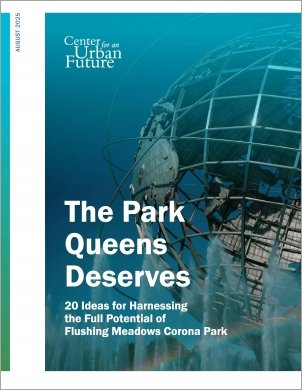
Flushing Meadows Corona Park is arguably New York City’s most underappreciated important park. It is the city’s fourth most visited park—behind only Central Park, Bryant Park, and Prospect Park—yet Flushing Meadows has long struggled to attract even a fraction of the public and private investment as other heavily trafficked parks. Although it was a symbol of urban modernity when it was first built as part of the 1939 World’s Fair, today much of the park feels dated, marred by deteriorating infrastructure, routine flooding, and faded monuments. And while it is regularly used by hundreds of thousands of Queens residents who have no other comparable public space option, it has surprisingly few green open spaces to accommodate the insatiable demand for soccer, ecuavolley, cricket, cookouts, and many other activities that today too often take place on modest stretches of grass—or dirt—between trees or adjacent to ballfields.
Despite its challenges, Flushing Meadows Corona Park is teeming with opportunity. It is the beating heart of Queens—a veritable backyard for residents of several of the city’s densest and most diverse communities, and a widely recognized icon of New York. On most weekends outside of the coldest winter months, the park becomes a hive of activity, with nearly every inch of green and open space used for picnics, children’s birthday parties, Zumba classes, tai chi, dance rehearsals, skate sessions, and running clubs. From canoe lessons and fitness programs for older adults to salsa dancing, open air movie nights, and unique community festivals, the park draws New Yorkers who depend on its vast acreage for recreation, connection, and well-being. It is home to five cultural institutions, two lakes, two major sports arenas, a golf course, and a marina. And it welcomes more than one million visitors for the U.S. Open and tens of thousands more for the Hong Kong Dragon Boat Festival, Queens Day, Governors Ball, and countless graduation parties, quinceañeras, Eid celebrations, and other family gatherings.
But it could be so much more. Flushing Meadows Corona Park has the potential to be one of the most dynamic urban parks in the country—and, crucially, a far more attractive and inclusive open space and recreational resource for the mostly low- and middle-income New Yorkers who use it on a regular basis. It could become a national model for equitable investment in public space—offering high-quality amenities, vibrant programming, connections among diverse neighborhoods, and safe, resilient infrastructure that uplifts the communities it serves.
“Flushing Meadows Corona Park is the ultimate crown jewel of our borough—a confluence of countless cultures, languages and cuisines in the shadow of Queens’ most historic landmarks and major sports stadiums,” said Queens Borough President Donovan Richards. “However, there are certainly plenty of upgrades and improvements that are needed throughout Flushing Meadows, as we work to cement its status as both the premiere neighborhood park for our neighbors and an international attraction for visitors from around the world.”
To realize its considerable promise, however, the park will require a new level of attention and civic focus on the future of this singular asset for Queens, bold thinking about what the park can become, and imaginative ideas not only for park programming but also for generating revenue.
Perhaps even importantly, it will need sustained public and private investment at a scale not seen in decades. Since 2012, only $100 million in city funds has been invested in the park, with over half of that—or $56 million, in total—going to a single project, the restoration of the New York State Pavilion, which holds little material benefit to park goers. Although federal funds for FEMA projects in the wake of Superstorm Sandy have added to the total investment, the park receives a fraction of the dollars it needs for basic upkeep. For example, it has been estimated that the sorely needed reconstruction of the Passerelle Pedestrain Bridge, which brings visitors from the Mets-Willets Point subway station to the park, and necessary upgrades to the park’s water and electrical systems would cost a combined $650 million.
.png)
But the challenges at Flushing Meadows Corona Park stretch far beyond just disinvestment. The park’s layout remains an artifact of the past, more fitting as a fairground than for open space uses. A series of roads and highways surround and cut directly through the park, making it less friendly to access or traverse on foot or bike. At the same time, buildings once used for the World’s Fair, like the Queens Museum and Queens Theatre, don’t feel well integrated with the park experience. Indeed, multiple people interviewed for this report said that the park often feels more like a collection of facilities on a campus than a magnificent public park. And it can often feel like a mission to find a functional bathroom or a bite to eat, with so few options available for park visitors.
All of the opportunities and challenges for Flushing Meadows Corona Park take on fresh urgency as a new soccer stadium and major redevelopment take shape at nearby Willets Point—and as policymakers weigh a proposal for a casino next to Citi Field. This report aims to spark the conversation about what should be done. It offers 20 concrete ideas for more fully harnessing the park’s enormous potential, addressing the park’s biggest challenges, and making it an even better, more vibrant, and more sustainable resource for residents across the borough and beyond. The 20 ideas were informed by more than two dozen interviews with parks and open space experts, community leaders from across Queens, regular users of the park, landscape architects, urban planners, and local policymakers—and they include both big visions for the park’s future as well as smaller ideas that can be implemented in the shorter term.
20 Ideas for Harnessing the Full Potential of Flushing Meadows Corona Park
1. Make a major long-term capital commitment to FMCP that allows the park to reverse years of inadequate attention to its core infrastructure needs.
2. Prioritize future spending to address FMCP’s persistent flooding.
3. Consider an "FMCP Flood Fund" to directly capture private revenue in the park for climate resiliency and mitigation upgrades.
4. Charge NYC DEP with repairing and replacing water mains and collapsed catch basins in FMCP.
5. Develop a 10-year strategic plan for FMCP that guides future investments and decision-making.
6. Develop ways to better integrate FMCP’s member institutions.
7. Expand Citi Bike and NYCDOT’s shared e-mobility pilot to the park.
8. Convert more of the park’s open spaces to multi-purpose fields and consider year-round usage of facilities.
9. Establish a signature event that brings visitors and attention to the park.
10. Cover one or more of the highways surrounding the park.
11. Daylight Flushing Creek to connect the park to Willets Point and the waterfront.
12. Reduce the amount of asphalt in FMCP.
13. Create dynamic new food options in park by establishing a new vendor market filled with local food entrepreneurs.
14. Open a new sit-down café or restaurant outside the Queens Museum.
15. Explore opportunities to more fully harness Queens Theatre and its prized position in the park— perhaps by launching free outdoor performances during summer evenings.
16. Create an "Emerald Necklace" of seamless park connections in central and eastern Queens, with Flushing Meadows Corona Park at the core.
17. Reimagine the entrances to the park, including a bridge over Flushing Creek.
18. Expand the NYC Ferry system to Willets Point, in exchange for pier upgrades.
19. Redesign the Playground for All Children.
20. Make better use of the area surrounding the New York State Pavilion.
View the full report by clicking here.