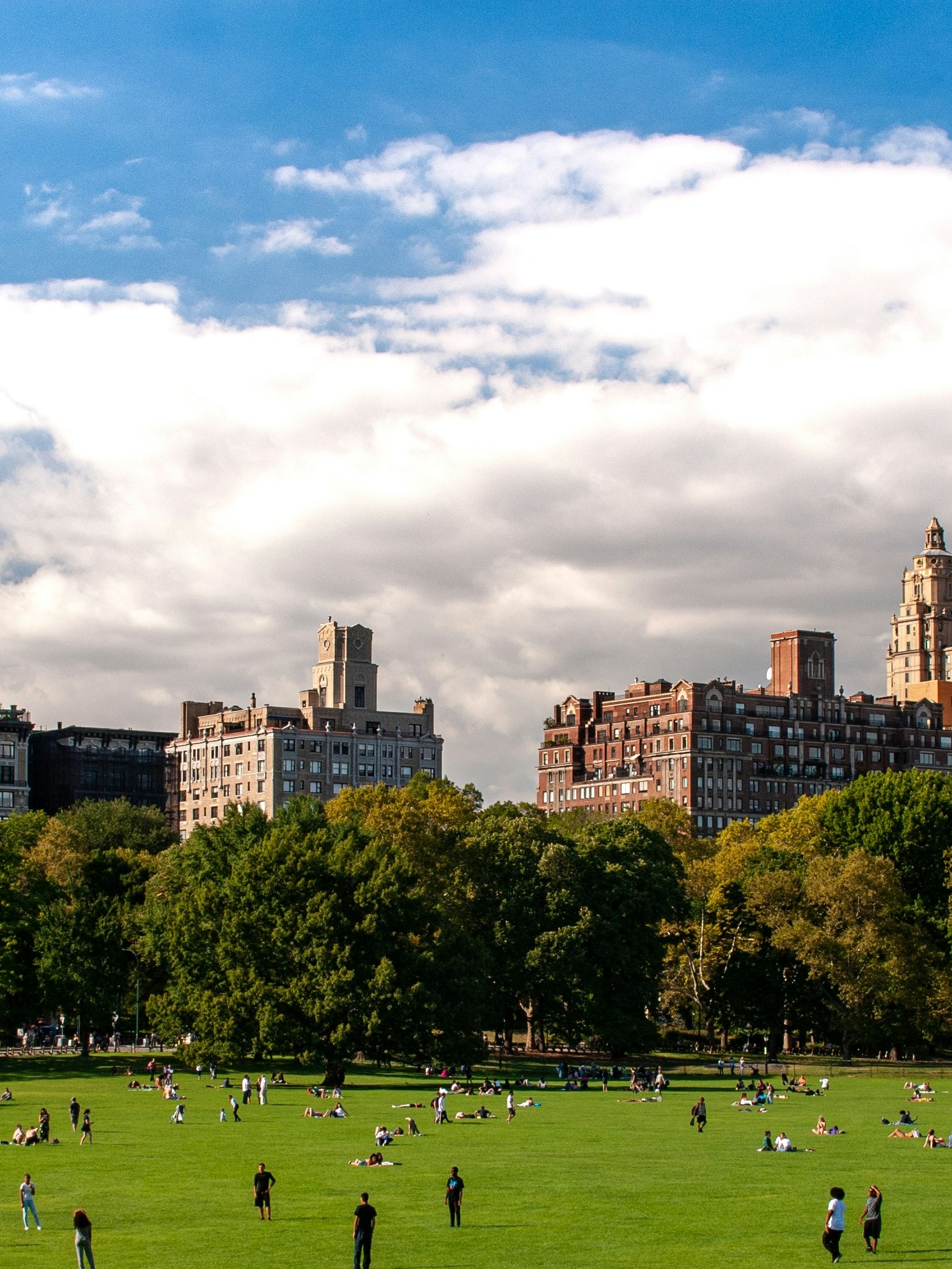
New York City has long been a place where movement is built into daily life—from walking miles of crowded blocks to playing pickup sports in schoolyards and spending summer days at neighborhood pools. But today, New Yorkers are moving less, spending more time indoors, and feeling more isolated. More than half of residents are overweight or obese;1 40 percent live with at least one chronic disease; and 41 percent report feeling frequently lonely.2 These challenges are disproportionately concentrated in low-income neighborhoods, where access to free, low-cost recreation is already limited and demand is high.
At the very moment when public recreation should be central to the city’s health strategy, it has steadily fallen down the list of priorities. In 2011, the NYC Department of Parks & Recreation shortened its public-facing name to NYC Parks as part of a broader brand overhaul—but the deeper shift away from recreation as a central priority had been underway for decades. Recreation once accounted for nearly one-third of the NYC Parks budget; today it represents around 5.3 percent. Full-time recreation staff have fallen from almost 2,000 to 659. And many core recreation assets—pools, rec centers, field houses, courts, and fields—are in need of urgent repairs or closed entirely, with more than $400 million in known capital needs for major facilities alone, and likely hundreds of millions more yet to be identified.3
The system is struggling to match the needs of the city it serves. Pool attendance is down 43 percent since before the pandemic. Fewer than 2 percent of New Yorkers are members of a recreation center. Participation in many core programs has fallen by 40 percent or more, driven by fewer offerings, limited staffing, and aging facilities. Access is very uneven: neighborhoods like Ozone Park, Midwood, and Mount Hope are “rec deserts,” with each public athletic facility serving more than 4,300 residents—triple the citywide average. And across the five boroughs, waitlists for fitness classes, swim lessons, and youth programs stretch longer each year, even as many communities have none at all. NYC Parks continues to do what it can with limited resources, but the gap between demand and capacity keeps widening.4
The city has taken important steps—renovating recreation centers, modernizing pools, and focusing on programs like swim instruction and Saturday Night Lights—but the scale of the challenge far exceeds current efforts and the resources available to NYC Parks. Other major cities are pulling ahead: Philadelphia, Chicago, San Francisco, and Minneapolis now spend between five and fifteen times more per capita on recreation than New York. Most U.S. cities serve fewer than 50,000 residents per recreation center; New York serves more than 200,000.5 Meanwhile, demand here keeps rising—Asphalt Green turns away 1,000 young athletes annually because field space is so limited, and record numbers of New Yorkers are applying for marathons, tournaments, and free parks programs.
Restoring recreation as a citywide priority—and expanding it far beyond parks alone—is one of the most powerful strategies available to improve health, reduce disparities, and rebuild social connection. Cities around the world show what’s possible, from Bogotá’s car-free Sundays and Paris’s reclaimed waterfronts to Philadelphia’s walking clubs, San Francisco’s “nature prescriptions,” and Atlanta’s transit-station soccer fields. New York has the scale and the need to lead again. To meet this moment, it’s time to put the “rec” back into Parks and Recreation—and to reimagine parks, streets, schoolyards, libraries, transit hubs, senior centers, NYCHA campuses, and waterfronts as places where every New Yorker can move, play, and belong.
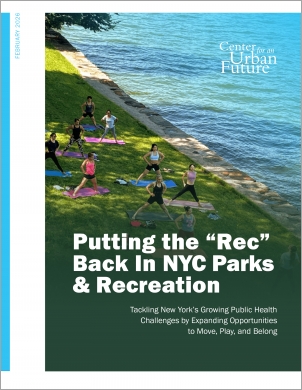
This report, supported by a grant from The Leona M. and Harry B. Helmsley Charitable Trust, explores the importance of public recreation in New York City, the challenges of expanding recreation, and solutions for meeting that demand. Along with analysis of data shared by NYC Parks, the Center for an Urban Future interviewed more than 75 leaders of parks alliances, nonprofit recreation providers, and community organizations in all five boroughs, as well as visitors to recreation centers, athletic facilities, and community programs.
The problem is clear: New Yorkers are more sedentary, and they are more socially isolated than ever before. Together, these challenges are having a tremendous effect on physical and mental health. And that impact is particularly outsized in low-income neighborhoods, where access to free, low-cost recreation is minimal but demand is high.
“Years ago the city invested in all kinds of recreational programs. It was amazing. I would have a packed gym with all these kids playing ball, hanging out with each other. Why don’t those programs exist anymore? Why can’t we do this and why isn’t there more of it?” says Robin Redmond, executive director of the Flatbush Development Corporation, which provides free afterschool and summer programs, including dance, soccer, and basketball to over 1,000 children and teens in Brooklyn. “To me there are endless possibilities of what we can do. There’s so much usable space. We just need to use it effectively.”
Studies show that more frequent use of public recreation spaces improves physical activity and mental health.6 Yet for many New Yorkers—especially in lower-income communities—these opportunities are scarce. Decades of underinvestment have left the city with an uneven landscape of free and low-cost recreation, even as other major cities have moved in the opposite direction. To create a stronger, more equitable, and healthier city, this will need to change.
New York City has been underinvesting in recreation for decades.
It wasn’t until 2011 that the New York City Department of Parks and Recreation shortened its official name to NYC Parks as part of a major brand overhaul—striking “recreation” in the process. But the erosion of recreation from the agency’s core mission had been decades in the making—even as NYC Parks continues to be the city’s largest and most frequented provider of recreational facilities and programs. Before the 1970s fiscal crisis, recreational facilities and programming historically accounted for about a third of the overall parks budget. But by 1984, following a decade of immense fiscal challenges, rec’s share had slid down to just 8.4 percent.
Today, recreation makes up an even slimmer share of the agency’s budget, at 5.3 percent in 2025, or about $32.8 million out of a roughly $618 million budget. Adjusting for inflation, the decline is even steeper—down from $129.8 million in 1964, a 75 percent decline.
The most visible effect is a steep decline in staffing and a reduction in programming—changes that have hampered the city’s ability to attract and introduce more New Yorkers to the power of recreation at exactly the time when it is needed more than ever. In 1964, the NYC Parks’ recreation division had 1,949 workers. In 2025, there were only 659, a 66 percent decline.7
Attendance at recreation facilities has declined.
Prior to the pandemic, visitation at the city’s public recreation facilities had already been declining, from 4.2 million in 2016 to just over 3 million in 2019. But since the pandemic, attendance has hit record lows and has not come close to recovering. Overall attendance is down from the 2.4 million New Yorkers who visited their local recreation centers in 1974, even though New York City is home to about a million more people now than in the 1970s. And while rec center visitors in 2024 rebounded to the highest level since 2019—1.9 million—that’s still 38 percent lower than 2019.8
It’s not only rec centers where visitation is down. Attendance at the city’s 65 public pools—a major source of recreation for countless New Yorkers—averaged 1.64 million attendees a year, from 2009 to 2019. But after the pandemic, the average has dropped to 929,475, or a 43 percent decrease. Attendance in programming that occurs outside of recreation centers also dropped in that time period, from over 1 million in 2017 to just over 600,000 in 2024—a 40 percent decline.
To be clear, some of the decline reflects sites closing for much-needed renovations. And when sites come back online, attendance typically soars—for instance, the reopening of the Astoria pool in 2024 more than doubled the borough’s annual pool attendance figures.9
But overall, the data presents a concerning reality: the city’s flagship public recreation facilities are serving fewer New Yorkers today than they were 50 years ago. Experts say that turning around this concerning trend will require a major expansion of free public programming—whether provided directly by the city or through nonprofit partners—so that more New Yorkers have support, encouragement, and guidance in taking advantage of the recreational facilities that already exist.
City-run recreational programming has fallen since the pandemic—even as New Yorkers need these opportunities more than ever.
While the presence of public athletic facilities is a boon for local residents, research shows that nothing increases park use and physical activity as much as programming—organized activities that help people make use of the space. In a study of 174 parks, researchers found each additional supervised activity led to a 48 percent increase in park use and a 37 percent increase in physical activity among park users.10
In a city grappling with an affordability crisis, free and low-cost recreation programming offered by NYC Parks is more important than ever to keeping communities healthy. In 2024, NYC Parks’ Recreation unit served nearly 50,000 different New Yorkers directly through 2,724 distinct programs, with options ranging from Latin dance and adaptive fitness to yoga and birding. Altogether, parks employees hosted 44,443 program sessions in 2024, totaling nearly a million visits including programs held both inside and outside the rec centers.
But this type of programming is not nearly at the levels it was before the pandemic. In 2019, NYC Parks offered nearly double the amount of programming as in 2024. On Staten Island and in the Bronx, programming is down over 60 percent since then. The decline cuts across programming types as well: yoga classes, for example, have dropped 89.4 percent; basketball, 70.9 percent. Shape Up NYC classes were offered 519 times and served 5,701 in 2019, but 490 times to 4,150 people in 2024—a decrease of about 27 percent. That drop is also seen in attendance: total attendance at recreation programs is down 19.6 percent since 2019.11
Our analysis also finds disparities in who has access to that programming and what’s available to New Yorkers. Even though it’s the third most populous borough, Manhattan had the greatest variety of programming in 2024, with 927 different kinds of classes or workshops to attend, followed by Queens (702) and Brooklyn (642).
The Bronx and Staten Island lagged far behind, with only 299 and 165 different types of recreational programming available, respectively. The total number of actual program sessions is unevenly distributed: Manhattan has the most, by far, at 15,300 unique sessions, followed by Brooklyn (10,967) and Queens (10,200), far outpacing the Bronx (4,465) and Staten Island (2,792).
What’s being offered varies greatly. For example, Manhattan and Brooklyn were home to the most strength training classes in 2024, with 1,625 and 1,577 respectively, while the Bronx hosted fewer than 10. Zumba was offered just twice on Staten Island, but 142 times in Brooklyn.
Meanwhile, residents on Staten Island and the Bronx had no spin classes available to them at all in 2024—and it was offered 56 times in Queens, 50 times in Brooklyn, and 42 times in Manhattan. Similarly, Shape Up NYC adult fitness programming was offered 251 times in Manhattan in 2024—but less than 100 times in the other four boroughs, including just three times on Staten Island.
In interviews, parks staffers told us that the diversity and frequency of programming that a recreation center, park, or athletic facility offers is limited both by available staffing and physical capacity. In 2024, large, popular facilities like Al Oerter Recreation Center, in Flushing Meadows-Corona Park, and the Chelsea Recreation Center hosted programming 3,225 and 2,773 times, respectively. But Lyons Recreation Center, in Tompkinsville, hosted programming just 185 times and J. Hood Wright Recreation Center, in Washington Heights, 380 times.12
New York City is lagging behind other cities.
When it comes to public recreation, New York City is an outlier. The city spends far less per capita than other major U.S. cities, including San Francisco, Chicago, Minneapolis, and Philadelphia. Comparatively, recreation also makes up a much smaller slice of the overall parks budget here than it does elsewhere. While budget categories vary across cities, available data consistently show New York spending far less per capita on recreation—and operating fewer recreation centers and athletic facilities relative to population—than its peers.
Los Angeles has 137 recreation centers for 3.9 million people—or 28,500 people per center. Chicago has 300, and Philadelphia over 150, even with populations less than a third that of New York’s. Practically every major city in the U.S. has one recreation center per 50,000 residents or fewer; meanwhile, the ratio in New York City is more than 200,000 to 1.13
Several neighborhoods are effectively “recreation deserts.”
Access to athletic facilities varies enormously across the five boroughs. In some neighborhoods, public fields and courts are abundant; in others, they’re almost nonexistent—leaving entire communities without a single place to play popular sports. While the average New York City community district has about 150 athletic facilities, some are far better served. Queens CB12 (covering Jamaica, Hollis, and St. Albans) has 294 athletic facilities, Brooklyn CB18 (Canarsie, Marine Park, and Flatlands) has 279, and Manhattan CB11 (East Harlem) has 240. But in several districts, the numbers drop precipitously—below 50 total facilities for tens of thousands of residents. These are New York’s athletic facility deserts:
- Bronx CB5 (Fordham, University Heights, Morris Heights, Bathgate, Mount Hope) — Only 27 athletic facilities—one for every 4,930 residents—and none with lights. The district lacks any public fields or courts for baseball, tennis, regulation soccer, cricket, bocce, netball, pickleball, hockey, lacrosse, volleyball, or frisbee.
- Brooklyn CB12 (Borough Park, Kensington, Ocean Parkway, Midwood) — Just 41 athletic facilities, compared with 279 in nearby CB18. CB12 has no baseball diamonds, cricket pitches, bocce or netball courts, or pickleball areas.
- Queens CB9 (Richmond Hill, Woodhaven, Ozone Park, Kew Gardens) — 41 facilities, versus more than 200 in neighboring Queens districts like CB7 (Flushing) and CB8 (Fresh Meadows). CB9 has no fields or courts for cricket, soccer, tennis, volleyball, bocce, netball, pickleball, football, hockey, lacrosse, or rugby—and not a single lighted field. Despite large South Asian and Caribbean communities where cricket is beloved, and Latino communities where volleyball is popular, residents have nowhere to play either sport.
- Brooklyn CB9 (Crown Heights, Prospect Lefferts Gardens, Wingate) — 48 total facilities, but missing any courts or fields for regulation soccer, bocce, pickleball, hockey, volleyball, or baseball.
- Bronx CB6 (Belmont, Bathgate, West Farms, East Tremont) — 48 facilities, with no courts or fields for pickleball, hockey, volleyball, cricket, lacrosse, rugby, tennis, or netball.
Together, these five districts are home to more than 600,000 New Yorkers but have just 205 athletic facilities combined—fewer than a single well-equipped district elsewhere in the city.14
Community organizations report increasingly unmet demand for affordable recreation among low-income New Yorkers, while facing several growing challenges.
As public resources for recreation have dwindled, the city’s recreation system increasingly relies on nonprofits and volunteer groups to connect New Yorkers to recreation. While hundreds of thousands of residents belong to gyms or pay for classes, those options are often out of reach for lower-income households. As Emily Stutts, co-founder of Bergen Bike Bus, notes, “They’re often not in your local neighborhood, and they’re not accessible by public transportation and often cost money, which creates an inherent barrier.”
Yet the most accessible, affordable programs are now struggling to keep up with demand. Nonprofit providers consistently report long waitlists and limited ability to expand—not because of lack of interest, but because of structural barriers. Most organizations surveyed for this report cite waitlists for at least one program—often with 100 or more people waiting—and many say they have turned away requests to serve additional neighborhoods or boroughs. Nonprofits cite nearly all of the same pervasive challenges, including unstable funding for programming, limited access to indoor and outdoor facilities, rising costs for insurance and equipment, and intense competition for permits—including with for-profit leagues that compete to use public space. (In November 2024, NYC Parks added a not-for-profit youth category and instituted a fee waiver, lowering costs for some nonprofits.)
“The minute we open up any kind of recreation class, whether it’s for young people or seniors, it’s filled,” says Michelle Neugebauer, executive director of the Cypress Hills Local Development Corporation in Brooklyn. “It’s filled and there’s consistent attendance. The problem for freestanding community centers like the one we have, is that you don’t have guaranteed expense money. We have a beautiful facility, but there’s no ongoing funding source for recreation.”
New York Junior Tennis & Learning (NYJTL) illustrates both the scale of demand and the mismatch between community interest and available infrastructure. The organization’s free community tennis program serves roughly 12,000 children each year—most from low-income families and communities of color—yet its Cary Leeds Center for Tennis & Learning site in the South Bronx is the only one of the city’s 136 Saturday Night Lights locations to offer tennis.
“Who would think that adolescent kids in the South Bronx on a Saturday night would want to play tennis? We did. We have 50 kids now coming to that program,” says NYJTL CEO Udai Tambar. “Communities will adopt certain sports as long as they have access to it. The question is, ‘Who has the access and who has the opportunity?’”
These constraints extend beyond youth sports. Organizations serving older adults, people with disabilities, and newly arrived immigrants report similarly high unmet demand—but face additional hurdles securing appropriate space.
For Fast Feet, which provides low-cost track and field programming for children with physical and developmental disabilities, crowded parks and limited access to quieter facilities make expansion difficult. As founder Suzie Clinchy explains, fee-for-service alternatives often cost “$100 an hour, $150 an hour,” while public and nonprofit options lack the indoor, yearround space and staffing needed to grow.
Demand is also rising for culturally relevant recreation—but facilities have not kept pace with the city’s changing population. Cricket—the world’s second most popular sport—has grown steadily in New York, driven by immigration from South Asia, the Caribbean, and the Middle East. In 2019, more than 3,100 permitted cricket matches took place in city parks, with interest surging further after the 2024 Cricket World Cup. But suitable facilities remain scarce. Cricket requires short, well-maintained grass, and even designated fields often fall short, forcing teams to travel outside the city to train. “There’s just not enough facilities available to accommodate the amount of people that want to play,” says Sufiyan Junaid of Gotham Cricket Club.
The city has made progress in upgrading recreational infrastructure and connecting low-income New Yorkers to programs—but even more is needed.
In recent years, the Adams administration made a historic investment in recreation. In FY 2025, $471 million in active capital renovation work was underway at recreation centers, with major projects at Brownsville Recreation Center (over $160 million) in Brooklyn and Roy Wilkins Recreation Center ($147 million) in southeast Queens. After years of temporary fixes, the Olympic-sized Astoria Park Pool, built in the 1930s, reopened after a $19 million renovation.
Additionally, the city has committed another half a billion dollars to build five new recreation centers. Two of those will include pools—the most significant effort of its kind in years. That includes the $141 million Shirley Chisholm Recreation Center, in East Flatbush, as well as the $62 million Arverne East Aquatic Center, the first public pool for residents on the Rockaway Peninsula.
NYC Parks has gotten creative with how it delivers recreation to New Yorkers who may not live near a recreation center. The Shape Up NYC program sends paid and volunteer instructors to parks, libraries, senior centers and other community spaces for pop-up programming. Kids in Motion offers free drop-in programming at playgrounds across the city—an evolution of the agency’s Playground Associate program. Saturday Night Lights keeps recreation centers open later on Saturdays. And NYC Parks is partnering with the Department of Education to program more pools in schools—part of Let’s Swim NYC, a $1 billion, five-year effort to invest in updating and building pools, teaching water-safety skills, and addressing the city’s chronic lifeguard shortage.
This effort is beginning to show signs of progress. A particular bright spot has been the rebound in recreation center membership. In FY 2025, the Parks Department reported 156,000 total members, surpassing the pre-pandemic level for the first time.15
Putting the “rec” back into “Parks & Rec.”
Despite these positive steps, New York City is facing a widening gap between the need for public recreation and the system built to deliver it. Demand for affordable, accessible ways to move, play, and connect is rising across the city, yet decades of underinvestment have steadily pushed recreation to the margins of public policy. Today, recreation accounts for just 5 percent of NYC Parks’ budget, leaving too many neighborhoods without the facilities, staffing, or programming needed to meet growing demand. Without decisive action, the city risks deepening health inequities, worsening social isolation, and continuing to underuse some of its most valuable public assets.
Meeting this challenge will require restoring recreation as a core civic priority—and doing so at a scale that matches New York’s needs. That means committing to a long-term shift in funding that moves recreation toward 20 percent of the Parks budget, paired with a citywide recreation master plan to guide capital, staffing, and programming decisions across all five boroughs. It also means lowering barriers and meeting New Yorkers where they are: initiatives like Rec Pass, which would use the city’s library system to unlock free recreation, and RecRx, which would allow healthcare providers to prescribe recreation as a preventive health tool, point the way toward a more integrated, people-centered system.
This report lays out a practical agenda to rebuild public recreation in New York City for the decades ahead. It calls for reinvesting in aging facilities, rebuilding the recreation workforce through initiatives like RecCorps, and harnessing private and philanthropic dollars through a Recreation Investment Fund to expand programming where public resources are stretched. At the same time, it urges the city to activate underused public infrastructure—from schoolyards and NYCHA campuses to waterfronts and transit hubs—so that recreation is woven into daily life across the five boroughs.
Read the full report here.
Read the report's recommendations here.
New York City has all the ingredients for a robust, inclusive recreation ecosystem: dense neighborhoods, a vast network of parks and open spaces, hundreds of schoolyards, an extensive transit system, and world-class public institutions. Yet too many New Yorkers still struggle to find affordable, accessible places to be active—especially in low-income communities, where aging facilities, limited programming, and unsafe streets make recreation far harder than it should be.
Reversing this trend will require a bold new commitment from the Mamdani administration to put the “rec” back in Parks & Rec and treat recreation as essential civic infrastructure. The following 11 ideas outline a practical, achievable roadmap for building a happier, healthier city—one where every New Yorker, in every neighborhood, can walk out their door and find ways to move, play, and connect. Together, they form the backbone of a citywide recreation strategy worthy of New York.
1. Make a long-term commitment to restoring recreation as a citywide priority—starting with a recreation master plan. For decades, recreation has become an afterthought in the city’s parks system: in the 1970s, recreational services made up nearly one-third of NYC Parks’ budget; today, it is just 5.3 percent. Attendance at recreation centers has fallen sharply even as the city has grown by more than a million residents. The mayor should commit to achieving his pledge of allocating 1 percent of the city budget to parks during his administration and restore recreation as a core mission of the agency—reversing years of disinvestment and truly putting the “rec” back in Parks & Rec. As part of this commitment, the city should set a goal of allocating 20 percent of an expanded parks budget to recreation, and fund and develop a recreation master plan for the 21st century, mapping current assets, identifying gaps, aligning programming with population needs, and launching a citywide recreation marketing campaign. Other cities have shown this is achievable: Boston and Minneapolis have both taken citywide, data-driven approaches to recreation planning, and Los Angeles has pushed to market recreational offerings widely. A five-borough strategy would give New York the blueprint it lacks today—one that ties capital, operating, and programming choices together and ensures recreation becomes a sustained civic priority.
2. Activate more of the city's existing public infrastructure for recreation—leveraging the unique opportunity of the 2026 World Cup to launch this citywide effort. New York has far more recreation potential than the formal Parks system alone—it simply isn’t being activated. Schools run the city’s largest organized recreation system, yet most buildings sit locked after 5 p.m. and on weekends. NYCHA manages 2,400 acres of land, the majority of which is fenced off or inaccessible, with too few functioning play spaces or community centers. The waterfront spans 520 miles, but only a fraction is accessible, swimmable, or set up for boating. And streets across the city—still dominated by cars—remain a vastly underutilized public asset for play, movement, and community life.
The Mamdani administration should leverage the historic opportunity presented by the 2026 World Cup to launch a coordinated, cross-agency strategy to open up these assets for recreation. That should start with expanding Schoolyards to Playgrounds and opening more school gyms and fields after hours, especially in neighborhoods with little open space. At NYCHA, the city should support and scale initiatives like Green Space Connections—which is already activating open spaces with deep resident input in eight developments—to reach dozens more campuses.
Along the waterfront, NYC Parks and state partners should expand modular kayak launches, create more safe swimming access points, and deploy simple storage solutions so communities can run boating programs close to where residents live.
Streets should also play a much larger role. Summer Streets should expand beyond five weekends and into more neighborhoods; the city should pilot recreation-forward street redesigns near schools to create “safe routes to play”; and revive its Weekend Walks program, which ended in 2019.
The MTA and NYC Parks should explore transforming key nodes along the coming IBX into recreation hubs inspired by Atlanta’s Station Soccer—where transit stations host sports programming and cross-class community activity.
And in partnership with NYC Aging, the city should bring more group programming, walking clubs, and tours directly to senior centers and older adult housing, ensuring older New Yorkers have consistent opportunities to stay active close to home.
Together, these actions would knit a much broader recreation network across the five boroughs—opening the school gym down the block, the NYCHA courtyard next door, the waterfront across the street, and even the local train station as places where every New Yorker can move, play, and connect.
3. Commit to a 10-year capital campaign to shore up aging facilities—and build new ones. Half the city’s recreation centers were built before 1950; roughly 40 percent of pools date back to the 1930s. Many have not seen major renovation in decades. Chronic leaks, HVAC failures, and outdated mechanical systems push New Yorkers away and depress usage. Although the Adams administration began to chip away at the more than $400 million state-of-good-repair backlog, the scale of need is far larger.
The Mamdani administration should launch a multi-year capital campaign to modernize every major recreation facility—with a focus on air conditioning, roofs, locker rooms, safer pools, and multi-purpose spaces. The effort should be paired with a citywide facilities assessment to ensure capital dollars are targeted where they will deliver the most benefit—including schools, CUNY colleges, and other publicly owned facilities. And the city should seize opportunities to build entirely new facilities—such as field houses, multiuse courts, and aquatic centers—especially in neighborhoods where recreation options are scarce and where major transit or land-use changes, like the upcoming IBX, will reshape community needs. To encourage development of these facilities, the city can also develop zoning tools, like exempting recreation facilities from floor area ratio (FAR) limits, enabling sports fields to become "green roofs" by combining the footprint of small buildings, and by encouraging subsurface space to be used to create new pools, by eliminating parking requirements.As part of this effort, the city should work proactively with nonprofit parters who can deliver free programming—from tennis to field hockey and beyond—to ensure that communities have access to recreational opportunities that might otherwise never be made available locally.
4. Launch Rec Pass, a new partnership with the city's public libraries to unlock free recreation citywide. The city’s 217 library branches reach every neighborhood and serve over 40 million visitors a year. With the right partnership, they can become powerful gateways to free and low-cost recreation. Modeled on Culture Pass, Rec Pass would allow library cardholders to access a set number of free classes or activities at recreation centers, pools, and partner nonprofits each month.
Rec Pass would help promote NYC Parks programming to a far wider audience, especially in low-income communities where awareness remains low. (Today, NYC Parks offers a discount to IDNYC holders to help boost membership, but the city should go further to build awareness of recreational offerings and serve more New Yorkers.) Rec Pass would also introduce first-time users to classes, workshops, or activities they might never otherwise try—from yoga and strength training to pickleball or family recreation nights. By lowering barriers to entry and meeting people where they are, Rec Pass would help thousands of New Yorkers get active.
5. Scale up NYC Parks' summer day camps to serve at least 5,000 children. For hundreds of thousands of New York City families, the summer break creates a major childcare and affordability challenge, with full-day camps often filling months in advance and costing $500 to $1,000 per week. NYC Parks’ Summer Day Camp is one of the city’s most effective and affordable options—offering a full day of outdoor recreation, sports, arts, and nature programming for just $500–$575 for the entire summer—yet it currently serves only a few hundred children each year across a limited number of sites. City leaders should significantly scale up this proven program to reach at least 5,000 campers annually by expanding it to more recreation centers and park facilities. Doing so would save families thousands of dollars per child each summer, generate meaningful fee revenue for Parks, and provide thousands more children with healthy, outdoor-focused recreation at a relatively modest public cost—while making better use of the city’s existing park and recreation infrastructure.
6. Create RecRx, a multi-agency effort to tie health spending directly to recreation. The benefits of physical activity to mental and physical health are overwhelming. Yet the health system rarely invests in recreation as a preventive tool. RecRx would change that by enabling healthcare providers, insurers, and city agencies to prescribe recreation to patients—whether free classes at a recreation center, guided park visits, or memberships at participating gyms.
Cities and states across the country offer models: pediatricians in the East Bay prescribe park visits; New Jersey’s Blue Cross Blue Shield covers six months of dance and cultural programming; Massachusetts’ CultureRx subsidizes arts and recreation activities; and Georgia’s Art Pharmacy provides “doses” of creative outings to improve mental health. A New York City adaptation could start with partnerships across the Department of Health and Mental Hygiene, Health + Hospitals, NYC Parks, and major insurers, offering a scalable way to expand access for New Yorkers who would benefit most. For example, major insurers could fund recreation programs, like making rec center memberships free, as a preventative care strategy and to reduce long-term healthcare expenditures.
7. Build a Recreation Investment Fund to harness private dollars for programming and facilities. The city cannot meet its recreation needs on public funding alone—especially in an uncertain fiscal environment. A Recreation Investment Fund would create a structured mechanism to receive and direct private dollars for programming, equipment, and facility upgrades in the neighborhoods that need them most. Professional sports teams already offer precedent: the Amazin’ Mets Foundation has funded field renovations in Flushing Meadows Corona Park, and New York City Football Club has partnered with parks across the city to build free soccer pitches through the Adopt-A-Park program. But these public-private partnerships have significant room to grow. A dedicated fund—potentially developed in partnership with the New York City Economic Development Corporation—would make these collaborations easier to initiate, finance, and sustain. This could also include new recreational concessions that incorporate free public access as part of their agreements with NYC Parks, expanding on some existing agreements that provide free access to golf, ice skating, tennis lessons, and other opportunities. A Recreation Investment Fund would also allow the city to pursue expanded corporate, philanthropic, and anchor-institution partnerships to support programming where public resources remain stretched.
8. Reverse staffing cuts and add full-time staff to open more athletic facilities seven days a week and expand programming. Only about one-third of recreation centers are open seven days a week. Staffing shortages also limit class offerings, outreach, and the ability to run consistent programming year-round. Policymakers should baseline funding to restore the 77 programming positions cut in recent budget reductions and add another 75 staff per year over the next four years to expand offerings.
Reliable, full-week access would dramatically increase usage, especially for working families, teens, and older adults. An expanded staff would allow centers to build stronger community relationships, offer more age-appropriate classes, and support the new partnerships and programming outlined in this report.
9. Pilot RecCorps, a workforce pipeline into recreation careers through CUNY, CTE high schools, and SYEP. NYC Parks faces persistent hiring and retention challenges—especially in aquatics, youth programs, coaching, and public-facing roles. RecCorps would build a structured workforce pipeline by linking CUNY campuses, Career and Technical Education high schools, and the Summer Youth Employment Program. (NYC Parks currently develops a small number of SYEP participants through an Aquatics Career Prep program—this should be expanded to dozens of other roles across the system.) Students could earn stipends or wages while working in lifeguarding, recreation programming, youth sports, outdoor education, and maintenance.
This strategy would create high-quality entry points into professions like sports medicine, coaching, physical education, aquatics, and youth development. It would also help fill chronic staffing gaps across recreation centers, pools, courts, and nonprofit providers—benefiting both young workers and the New Yorkers they serve.
10. Create a "trusted partner" program for nonprofits providing regular recreation services. Nonprofit organizations fill essential gaps in the city’s recreation ecosystem, offering programs from yoga and dance to youth sports and martial arts. Yet these groups often face barriers: complicated permitting, inconsistent access to indoor and outdoor space, no storage, and little to no marketing support.
A trusted partner program—modeled on programs that support Business Improvement Districts—would allow for multi-year permits to give nonprofits an advantage in the competition for space and to fundraise and market with more long-term certainty, would streamline access to equipment, set aside rooms or courts for high-performing partners, and provide basic marketing assistance and access to programmatic city funding. This should build on—and go beyond— the current, highly effective partnership between NYC Parks and the City Parks Foundation. This approach would ensure that nonprofits offering high-quality, community-rooted programming can reliably reach more New Yorkers.
11. Make it easier to recreate in parks through mobile and modular amenities. Parks near many New Yorkers’ homes lack even the simplest amenities—balls, paddles, portable nets, or equipment for kids. The city’s Play Mobile fleet and playground associates provide some support but it is far too small for a city of 8.5 million. Policymakers should think creatively about bringing recreation directly to more neighborhoods through vending machines stocked with handballs or jump ropes, pop-up kiosks offering tennis rackets or scooters, and mobile concessions that rent paddleboards, roller skates, or other equipment. These low-cost, high-reach strategies can transform passive open spaces into hubs of activity and make recreation easier for families who cannot afford equipment or do not live near a recreation center.
Endnotes
1. New York City Department of Health, Environment & Health Data Portal. Overweight data. 2022. Overweight or obesity (adults). https://a816-dohbesp.nyc.gov/Indicator-Public/data-explorer/overweight/?utm_source=chatgpt.com&id=2063 on 01/23/2026.
2. New York City Department of Health and Mental Hygiene. 2024. The State of Mental Health of New Yorkers. New York, NY: NYC Department of Health and Mental Hygiene. https://www.nyc.gov/assets/doh/downloads/pdf/mh/state-of-mental-health-new-yorkers.pdf
3. Analysis of budgetary, staffing, facilities and programming data provided to Center for an Urban Future by NYC Parks.
4. Ibid.
5. CUF analysis of population data from each city in the U.S. Census, and recreation and community center numbers taken from each city’s parks department website in January 2026.
6. Orstad, Stephanie L., Kristin Szuhany, Kosuke Tamura, Lorna E. Thorpe, and Melanie Jay. 2020. “Park Proximity and Use for Physical Activity among Urban Residents: Associations with Mental Health.” International Journal of Environmental Research and Public Health 17 (13): 4885.
https://doi.org/10.3390/ijerph17134885.
7. CUF analysis of budgetary, staffing, facilities and programming data provided to Center for an Urban Future by NYC Parks.
8. Ibid.
9. Ibid.
10. Nagel, Catherine. 2018. “Active Parks, Healthy Cities.” Parks & Recreation Magazine, December 7. https://www.nrpa.org/parks-recreation-magazine/2018/december/active-parks-healthy-cities/.
11. CUF analysis of budgetary, staffing, facilities and programming data provided to Center for an Urban Future by NYC Parks.
12. Ibid.
13. CUF analysis of number of recreation centers taken from each city’s parks department website. 2026.
14. CUF analysis of budgetary, staffing, facilities and programming data provided to Center for an Urban Future by NYC Parks.
15. Ibid.