Testimony of John Surico
Senior Fellow for Climate and Opportunity, Center for an Urban Future
Before the New York City Council
Committee on Cultural Affairs, Libraries and International Relations,
jointly with the Committee on Contracts and the Committee on Transportation and Infrastructure
Good afternoon, and thank you for the opportunity to testify today.
My name is John Surico, and I’m the Senior Fellow for Climate and Opportunity at Center for an Urban Future, an independent research organization focused on building a stronger and more equitable New York City.
I’d like to begin by commending Chairs Abreu, Restler, and Williams, Council Member Krishnan, and members of the committees for focusing on an issue that rarely makes headlines but has huge consequences for New Yorkers. At a time of fiscal uncertainty, New York City needs to stretch capital dollars farther than ever before to continue delivering the vital facilities and spaces that residents rely on.
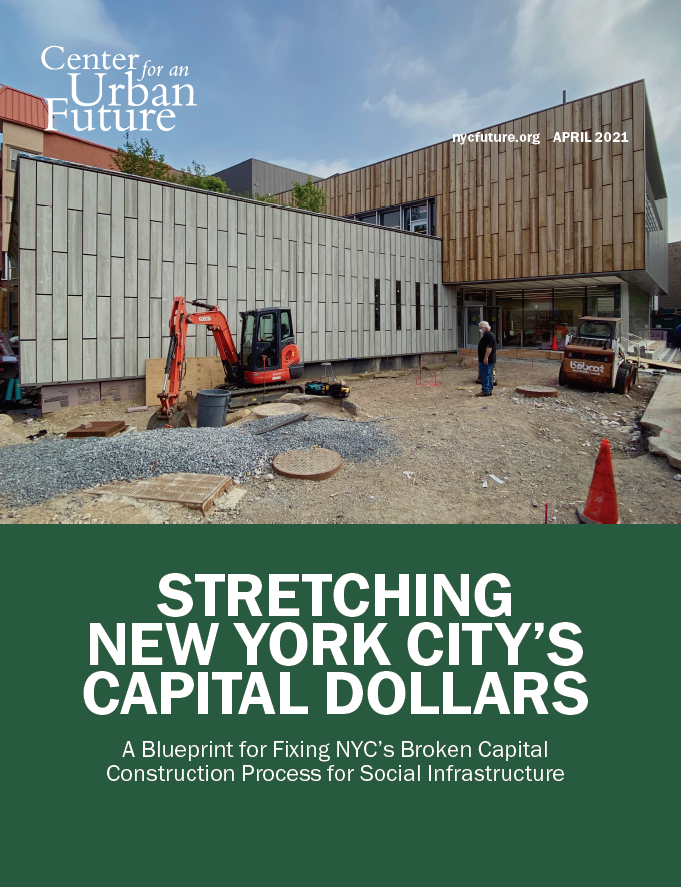
This is an issue the Center for an Urban Future has focused on for many years. In our 2021 report, Stretching New York City’s Capital Dollars, we called for every agency and office with a capital portfolio or oversight role to launch a capital project delivery blueprint—building on important work already underway at the Department of Design and Construction (DDC). We’re glad to see Intro. 263 advance that same idea, and we appreciate the Council’s leadership in moving it forward.
The need is urgent. The city’s parks, libraries, cultural institutions, and other vital civic infrastructure face billions of dollars in unmet state-of-good-repair needs. And with higher interest rates constraining the city’s ability to borrow, officials will need to get every drop out of our limited capital dollars.
But despite some important progress, capital projects still cost too much and take too long.
Our research has shown that a new public library can cost more than $2,000 per square foot and take over seven years to complete—more than a luxury office tower. Delay is one of the biggest drivers of those costs: each month added to a timeline can add hundreds of thousands of dollars to a project’s final price tag.
Too often, processes originally designed to safeguard public dollars are now doing the opposite—adding delay, driving up costs, and delivering less value for taxpayers.
There is also reason for optimism. DDC has made important progress through its strategic blueprint for capital project delivery improvements. The agency has cut the median building project duration by 11 months since 2019 and median infrastructure project duration by 18 months, while making use of faster delivery tools like design-build.
The next step is to make this approach truly systemwide. Building on DDC’s progress will require streamlining every stage of the capital process—from how elected officials fund projects, to community engagement, design, procurement, construction, and closeout.
That means extending this blueprint approach to every agency that manages capital projects, including the New York City Department of Parks and Recreation and the New York City Department of Transportation, as well as offices whose approvals and reviews can add months to timelines—especially the New York City Office of Management and Budget, including the certificate-to-proceed process, and the Office of the New York City Comptroller. If New York is serious about building faster, reform has to reach every part of the system.
City leaders should also continue partnering with New York State to secure additional tools that can accelerate timelines and lower costs—from broader design-build authority to construction manager at-risk and best-value contracting, so agencies can choose the right tool for the job, not simply the lowest upfront bidder.
The new Shirley Chisholm Recreation Center in East Flatbush shows what’s possible. Led by DDC, the new recreation facility was one of the first city projects to utilize design-build. The contracting method is credited with reducing the timeline by three years and shaving 10 percent off the final bill—more than $10 million in taxpayer savings.
New York cannot afford a capital process that wastes time and money. Intro. 263 is an important step toward a city government that can deliver projects faster, smarter, and at lower cost.
Thank you for the opportunity to testify today.




_291_388_bor1_a4a4a4.jpg)